
Mapping Plants to Educate and Connect with the Muslim Community’s Culture and Relationship with Earth
Michigan, Wisconsin, United States
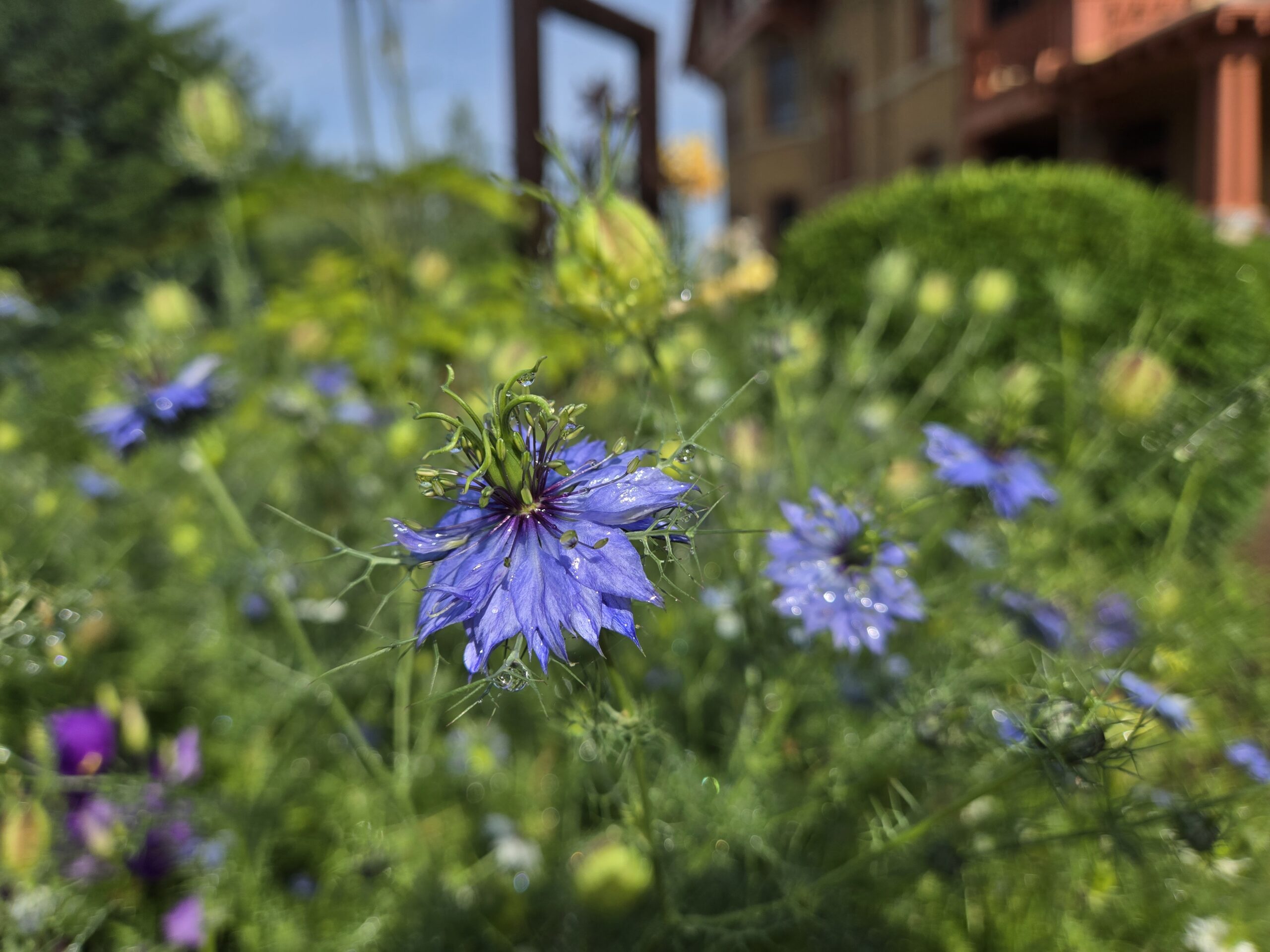
This project seeks to deepen connections between Muslims in Wisconsin and Michigan and the natural world by expanding their ability to recognize and identify culturally important plants. The project team plans to do this through offering training workshops on how to identify plants mentioned in the Qur’an and Hadith, empowering community members to identify these plants in their community, and sharing their contributions on a digital map of plants found in Wisconsin and Michigan gardens and natural areas. By increasing knowledge and awareness of plants, this project will deepen emotional and spiritual connections to the local plant community, inspiring care and protection for the local environment.
Resultados
Resumen del proyecto
This project seeks to deepen connections between Muslims in Michigan and Wisconsin and the natural world by expanding their ability to recognize and identify culturally important plants. To do this, this project involves an online platform through iNaturalist that allows people to learn about and participate in sharing observations about plants. To support this online project, the project team is also hosting in-person workshops to help people connect with plants mentioned in the Qur’an (the holy book for Muslims) and Hadith (reports on the sayings and traditions of Prophet Muhammad) and learn how to identify them.
Ultimately, the project’s goal is to inspire more people to become involved in Michigan and Wisconsin Green Muslims groups and for this project to build an Islamic landscape architecture-style garden at Allen Centennial Garden and other location(s) featuring some of these plants. By increasing knowledge and awareness of plants, these projects will deepen emotional and spiritual connections to the local plant community, inspiring care and protection for the local environment.
About 20-30 people attended each workshop. Approximately 300 people were engaged in these presentations.
Resultados del proyecto
- In summer and fall of 2025, the community created a project on iNaturalist that allows anyone in the upper midwest (Michigan, Wisconsin, and Minnesota) to contribute plants to the project as they find them in gardens and wild places near them. The project is set up to only include submissions of plants that are on a list of plants included in the Qur’an and Hadith. This also makes it a useful teaching tool for people who are interested in learning what these plants look like because they can visit the site without contributing as well. The project is called Plants in Islam and can be found here.
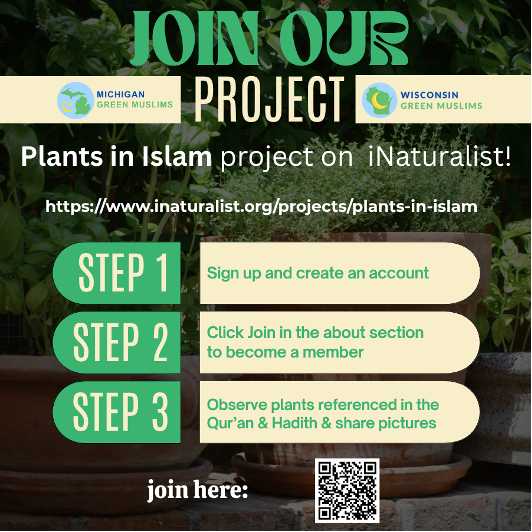
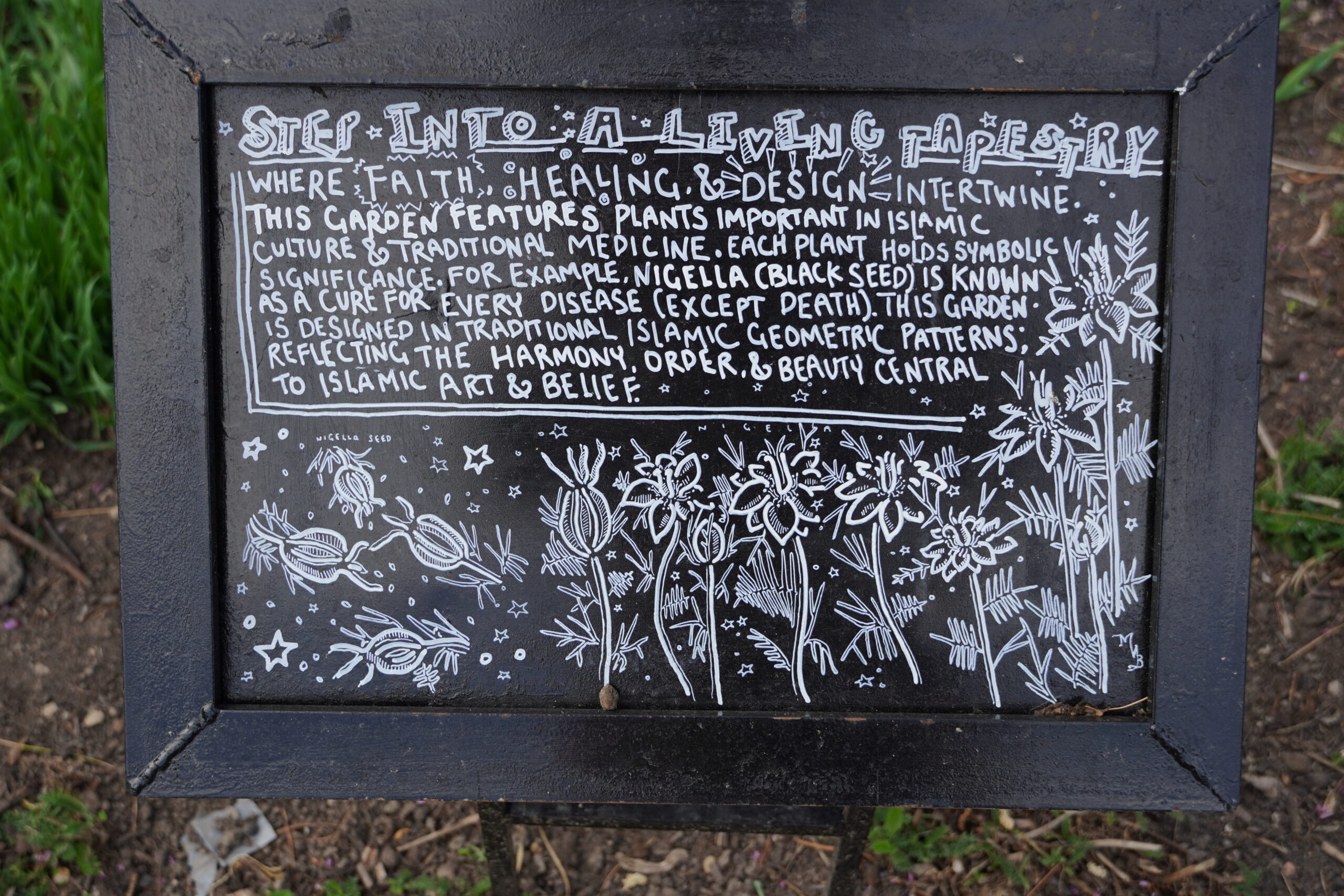
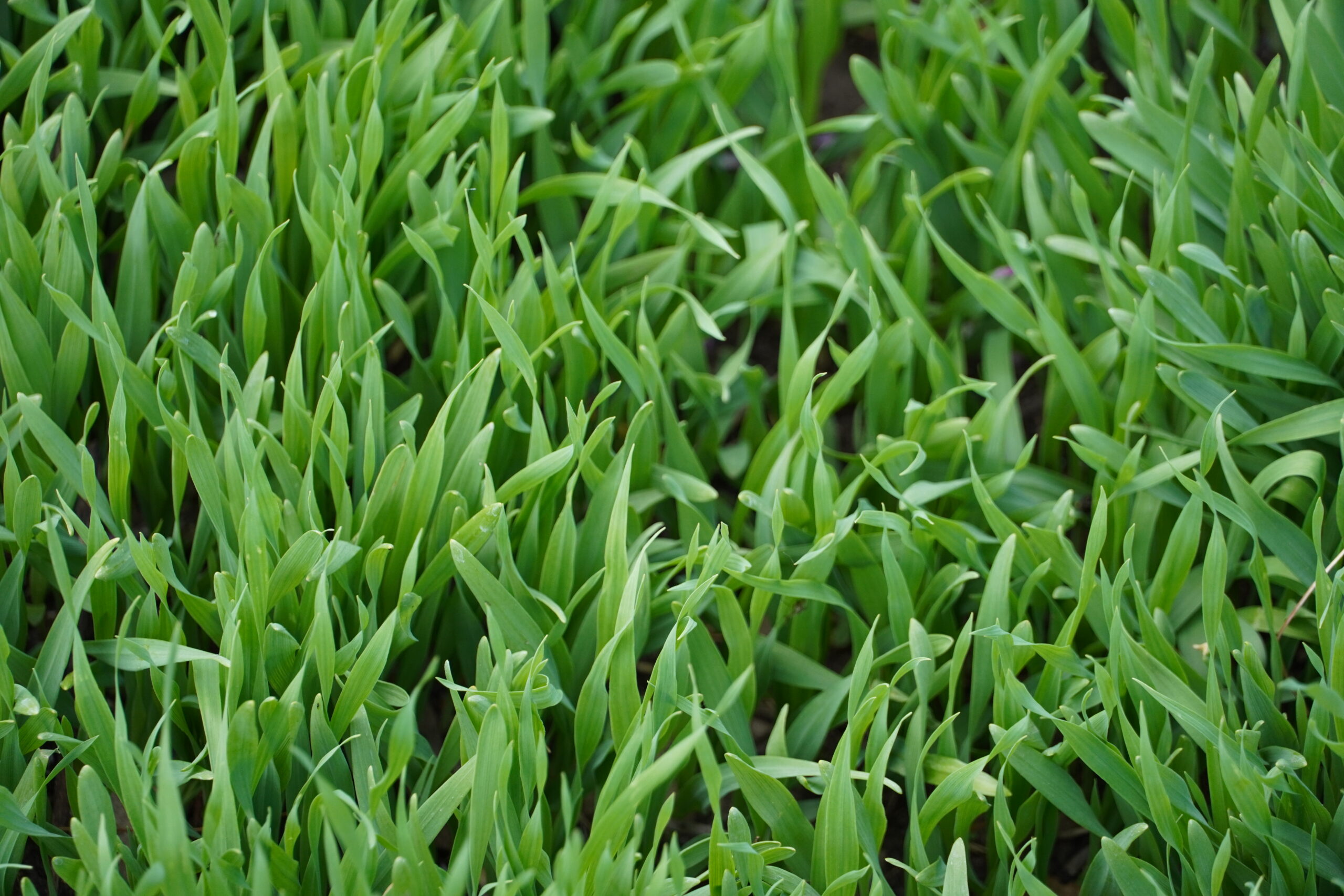
- In addition to launching the online project, the project team has also hosted a number of educational workshops and events in Michigan and Wisconsin to promote the project.
- In September 2025, the Islamic Science, Technology, Engineering, and Math (iSTEM) Student Group at the University of Wisconsin-Madison hosted an event at Allen Centennial Garden in collaboration with Wisconsin Green Muslims. The event included an activity to learn about plants in the Qur’an and Hadith, a tour of those plants in the Garden, a visit to a garden designed using traditional Islamic geometric principles and plants, and an introduction to the iNaturalist project.
- In October 2025, the Saturday School at the Islamic Center in Madison hosted speakers from Wisconsin Green Muslims and the Allen Centennial Garden to teach students about the importance of sustainability and nature in Islam. The workshop began by having students stand and stretch their arms out like branches and addressing questions like “How can we, as people, be like a tree? Can we be less wasteful and use our resources wisely, like trees do?” After tree pose, students split their time between a garden activity outside and learning about sustainability inside. Outside, students explored the garden, drew their favorite plants, and learned about gardening. Inside, they were taught the importance of nature and plants in Islam and how to take care of them. The workshop wrapped up with students sharing their favorite plants, and the importance of plants in their cultures and religion.
- These workshops show that science and faith are complements, each offering helpful ways to understand and care for the natural world. When community and faith leaders take part in community science, they help connect scientific ideas to everyday life and bring community values back to scientists. As this project grows, this partnership between science and faith will continue to guide our efforts to inspire care and stewardship for the local environment.
Community Impact
The community learned about plants in Islam, inspired by connecting to traditional knowledge, faith-based stories, and cultural and historical meanings rooted in the Qur’an and Hadith, and Muslim traditions.
Acknowledgements
Allen Centennial Garden, Michigan Green Muslims, Wisconsin Green Muslims
Future Plans
Michigan Green Muslims and Wisconsin Green Muslims might build on the foundation in this project in their outreach and educational programs. There is no funding for this work at this time.
Descripción
Acerca de la Comunidad
The Wisconsin Green Muslims community is spread out across the state, and centers in the state’s largest cities, Madison and Milwaukee. The community is currently growing to include Muslims in Michigan as well. Community members share a Muslim identity and an interest in the environment. It is a grassroots environmental justice group formed in 2005, intends to educate the Muslim community and the general public about the Islamic environmental justice teachings, to apply these teachings in daily life and to contribute to collaborations and coalitions working toward a just, healthy, peaceful and sustainable future. Currently, Wisconsin Green Muslims and Michigan Green Muslims are focused on creating a community space to teach about plants in the Islamic tradition and enjoy the natural world. Working with Thriving Earth Exchange provides an exciting opportunity to expand people’s awareness in this project and to open opportunities for them to participate directly.
Sobre el proyecto
The community would like to expand local awareness about plants that are mentioned in the Qur’an and Hadith, especially those that can be grown in Wisconsin and Michigan. In order to achieve this goal, the project team plans to engage Muslim community members from across these states in virtual or in-person workshops that teach about these plants, how to grow them, and how they can be identified. Then, these community members will be able to go out and identify these plants in their own communities and submit pictures and data about where the plants are already living. These submissions will then be displayed on a digital storymap to enable the project team to better understand which culturally-relevant plants can be found where we live and to share this information with other members of our community. This storymap will be shared online, including on the Wisconsin Green Muslims, Allen Centennial Garden, Michigan Green Muslims, and Thriving Earth Exchange websites. By increasing the community’s awareness of how to find and grow cultural plants through both workshops and access to the map, this project will deepen the connections between their faith and the natural world, inspiring them to be caretakers of plants and our shared environment. We will also build a community connected to plants that will care for, use, and support this future Islamic Garden space at Allen Centennial Garden.
Calendario e hitos
September 2024-January 2025: Project Scoping
January-March 2025: Recruit and onboard scientists/experts. Create data collection protocol and infrastructure
March-April 2025: Develop workshops to teach people how to identify our key plants and collect data
April-May 2025: Launch workshops in-person and online
May- November 2025: Collect data from community members
November-January 2025: Create storymap/website to share map (2 months)
January-March 2026: Launch public-facing storymap/website and promote
Equipo del proyecto
Líderes comunitarios

Huda Alkaff is an ecologist, environmental educator, and the founder and director of Wisconsin Green Muslims, a grassroots environmental justice group formed in 2005 connecting faith, environmental justice, sustainability, and healing through education and service. Huda’s higher education degrees are in Conservation Ecology, Sustainable Development, and Science/Environmental Education from the University of Georgia. For over two decades, Huda initiated Muslim and interfaith programs on energy democracy and water equity. Huda works at the Center for Community Stewardship, was a Program Manager at Milwaukee Environmental Consortium and is the Coordinator of Wisconsin Faith Communities for Equitable Solar Initiative that connects with over 10,000 people from 19 different faith traditions, spiritualities and various backgrounds. She recently co-chaired the US Climate Action Network 100% Equitable Renewable Energy Action Team. Huda has received numerous awards for her work including the 2015 White House Champions of Change for Faith Climate Justice Leaders by President Obama. Since 2024, Huda facilitates the Michigan Green Muslims environmental justice group.

Reba Luiken is the director of Allen Centennial Garden where she works as an architect of encounters, creating educational experiences that help deepen connections among people and plants. She holds a Ph.D. in History of Science, Technology, and Medicine as well as bachelor’s degrees in Religious Studies and Plant Biology from the University of Minnesota. Her expertise includes public history, public communication of science, digital humanities, nature journaling, and history of science and religion. She has worked in museums and public gardens including Longwood Gardens, the Minnesota Historical Society, and the Minnesota Landscape Arboretum for over ten years.
Científico comunitario

Isaac Zaman is a Muslim man who was born in Minnesota and spent much of his childhood in Wisconsin. He graduated from the University Wisconsin- Madison, where he started his career and found his passion for public garden spaces. He now works as a Horticulturist at Marjorie McNeely Conservatory where he grows, studies, and designs with plants. He is familiar with many aspects of plants to be used by people and is engrossed with creating spaces for communities to enjoy. The muslim community lacks places tied to nature that reinforce their faith and he wants to be a part of building that space.
Becario científico comunitario

Yixin Sun, known to many as Sunny, is a PhD candidate in economics at the University of Chicago Booth School of Business. Her research focuses on understanding the impacts of air pollution and people’s perceptions surrounding these impacts. Sunny employs a diverse toolkit of field experiments, surveys, and econometric methods in her work. Committed to fostering inclusive and comprehensive research, Sunny actively collaborates with a wide range of stakeholders, including local NGOs, policymakers, and fellow researchers from diverse backgrounds. This collaborative approach has broadened her perspective on the definition of research expertise. When she’s not looking at air pollution data, Sunny enjoys swimming, watching comedy, and embroidering.
Collaborating Organizations

Wisconsin Green Muslims is a grassroots environmental justice group formed in 2005, intends to educate the Muslim community and the general public about the Islamic environmental justice teachings, to apply these teachings in daily life and to contribute to collaborations and coalitions working toward a just, healthy, peaceful and sustainable future. Currently, Wisconsin Green Muslims is focused on creating an Islamic Garden as a community space to teach about and enjoy the natural world. They will serve as a key community catalyst, helping us connect with community members and community groups interested in our project.

Allen Centennial Garden is a 2.5 acre public garden on the campus of the University of Wisconsin-Madison. The Garden is open daily to the public for free. Its mission is to create garden experiences that deepen relationships among people and plants. Currently, Allen Centennial Garden is collaborating with Wisconsin Green Muslims to design and build an Islamic garden within our space. We also bring connections to UW-Madison students, a rich understanding of how to grow and display plants, and experience communicating with the public about plants as assets to this project.

Michigan Green Muslims is a grassroots environmental justice group formed in 2024, intends to educate the Muslim community and the general public about the Islamic environmental justice teachings, to apply these teachings in daily life and to contribute to collaborations and coalitions working toward a just, healthy, peaceful and sustainable future.
Creation Justice Ministries

Partnering with faith communities to address sustainability and environmental health concerns.
Status:
Complete,
Location:
Michigan,
Wisconsin,
Managing Organizations:
Creation Justice Ministries,
Thriving Earth Exchange,
Project Categories:
GIS,
Islam,
Plants,
Project Tags:
No tags