
Assessing the Impacts of Proposed Data Centers on Air Quality and Water Resources in Jackson, Mississippi
Jackson, Mississippi, United States
Breve descripción
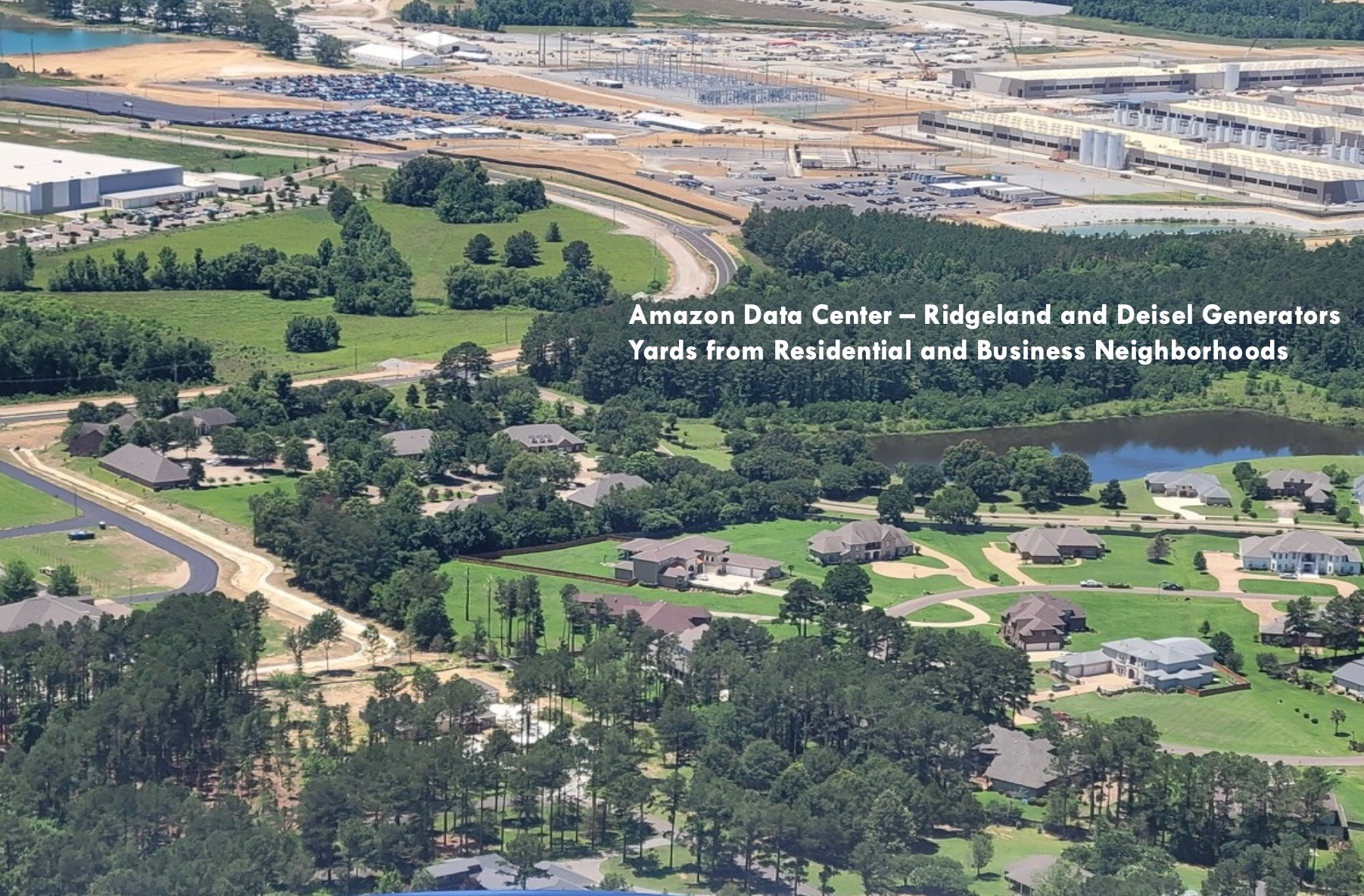
In response to the rapid development of multiple data centers and accompanying power generation facilities in close proximity to Jackson, MS, this project aims to establish and begin implementing a framework that will help residents monitor and assess air emissions and impacts as a community. The project will recruit an air quality expert who can help design a multi-site outdoor air quality monitoring experiment. The project aims to begin taking measurements at some sites before all plants have been built, to establish a baseline for potential changes in air quality. Additionally, the project aims to increase understanding of the proposed facilities’ impacts on local water resources. The project will recruit experts who can research and determine the most likely methods of cooling used in these facilities, and predict the consequences of those cooling methods on Mississippi’s specific water landscape.
Descripción
About the Community
This project centers the residents and HOAs of Jackson, MS and the adjacent city of Ridgeland, MS, who are represented by members of Environmental Advocates Mississippi (EAMS), a grassroots nonprofit dedicated to protecting Mississippi communities from toxic developments proximate to their neighborhoods, schools, places of faith, and businesses.
Jackson is a majority-Black community with a history of chronic disinvestment, burdened by ongoing environmental justice issues, including deteriorating water infrastructure and impacts of existing industrial plants. In January 2024, the MS State Legislature passed SB2001, an economic development bill that allowed the rapid development of data centers and power plants with extremely limited transparency and accountability to local community members. In the face of this lack of transparency, the community has identified two key local priorities. The first: to establish external measurement and monitoring protocols to assess and record the environmental and public health impacts of these developments. The second: to establish an external assessment of the proposed facilities’ water usage and its expected impacts on community water resources. EAMS is working with Thriving Earth Exchange to learn how to continue to advocate for themselves based in science, and empower the community to advocate for healthier living conditions.
Sobre el proyecto
This project seeks to strategically assess and monitor air and water quality as the greater Jackson, MS area experiences continued impacts from data centers and associated fossil fuel buildout. The project aims to empower the community to advocate for healthier living conditions.
Water
The main objective of the water impact assessment is to better understand the threat this incoming infrastructure poses to residents’ water resources and health. The Jackson metro area has several large-scale data centers in various stages of operation, construction, or planning — along with at least one new large combined cycle natural gas power plant to power them — but the impacts on water resources of these facilities is not clear because information about cooling technologies, water withdrawal, water consumption, effluent, and water source have not been fully disclosed.
Meanwhile, residents already experience failing water infrastructure, with regular “Boil Water” notices and inadequate funding allocated to improve the system. They are now concerned how these new plants could threaten existing water resources.
Understanding what information is publicly available is part of the challenge. It is difficult for non-experts to know what permits to look for, and how to interpret what is and is not publicized. The community seeks to understand the most likely cooling method each of the proposed data centers will use, how much water those methods will use, and what effluent is generated for each. This will require an expert with knowledge of water permitting requirements (Mississippi and federal, to the extent applicable), who will know what documentation to look for, and knowledge of cooling systems.
In addition to understanding the amount of water withdrawn and consumed, and likely cooling technologies used, the community seeks to identify the water source the plants will most likely draw from. The community anticipates this will require a hydrologist with knowledge of Mississippi’s landscapes. The hydrologist would look at the cumulative impact of all the proposed data centers in Mississippi. The community hopes this information will direct them towards a feasible, relevant approach to water monitoring and enable them to more effectively advocate for mitigations.
Aire
In the first phase of the air quality assessment, with the guidance of the scientist(s), community members will install outdoor air quality sensors that are appropriate for emissions associated with data centers (i.e., backup diesel and/or gas generators) and the natural gas power plant. The scientist will train residents on data collection. The data will be uploaded to a publicly available website, where residents can see air quality in real time, to be evaluated by present and future researchers. In the second phase of the project, the scientist(s) will design a more robust emissions monitoring approach, to be implemented beyond the 18-month Thriving Earth Exchange timeline.
Residents anticipate an increase in respiratory and other health issues associated with the emissions of criteria and hazardous air pollutants. This is a fear grounded in lived experience and knowledge of nearby communities’ experiences, as well as established science.
Summary
By gathering informed predictions of the facilities’ water usage, and by establishing a scientifically rigorous baseline assessment of local air quality and a blueprint for continued monitoring, Jackson residents will be better equipped to pursue their goals to protect themselves and their community from industrial harm. Given the sudden influx of data centers planned around the US, the findings and tactics of this project can be shared with other communities facing similar challenges, and may help inform their plans to defend their environment and health. The community hopes to produce a technical paper that demonstrates, through this case study, one way of bringing technical competence to a community, which can be shared with other groups.
Calendario e hitos
- Scope finalization and publication of project webpage on TEX website – September 2026
- Recruitment of scientists/experts – Fall 2026 – ongoing
- Set up preliminary air sensors and begin data collection – Winter 2026
- Design multi-site air monitoring experiment – Winter 2026
- Cooling expert researches most likely cooling method used and estimates water usage – Winter – Spring 2027
- Mississippi hydrologist researches most likely source of water – Winter – Spring 2027
- Install multi-site air monitoring experiment with additional sensors – Spring 2027
- Air quality data collection/analysis. Make data publicly available – Spring 2027 – ongoing
- Create a model or set of standard procedures of air quality monitoring through iteration that community members can continue to follow and apply to other metrics – Summer 2027
- Compile findings and share with community – continuously, particularly in Summer – Fall 2027
Equipo del proyecto
Community Leads
Yolanda Daniel is a community advocate and nonprofit leader dedicated to protecting the health, safety, and quality of life of communities across Mississippi. As a representative of Environmental Advocates Mississippi, she works to educate, organize, and empower residents, homeowners, taxpayers, and local leaders around issues that impact environmental health, economic stability, ecological integrity, and community well-being. Her advocacy centers on equipping communities with the knowledge and tools needed to confront harmful developments and promote sustainable, community-focused solutions. Grounded in civic leadership and environmental justice, Yolanda Daniel stands in principled opposition to the unjust placement of toxin-laden and similarly harmful developments that threaten public health and environmental safety. Her work focuses on defending individuals, families, neighborhoods, and community institutions—including schools, faith-based organizations, and local businesses—from developments that contribute to pollution and create long-term environmental and public health risks. Through grassroots organizing and public advocacy, she remains committed to ensuring communities are treated with dignity, fairness, and respect.

Catherine Casomar is a co-founder of the Better Data Center Project, which works in solidarity with communities on the front lines of data center development to realize the just distribution of economic, social, and environmental costs and benefits. Catherine has 15 years of experience in energy and climate and a decade operationalizing equity and justice across sectors, including as Director of the Community and Jobs team at DOE’s Office of Clean Energy Demonstrations, where she ensured clean energy and climate infrastructure projects worth over $85 billion delivered local community benefits and quality jobs. Prior roles included leading environmental justice portfolios in DOE and the US Senate, research to advance cheap next-generation solar cells, community organizing for racial and economic justice, and mechanical engineering on a variety of energy generation technologies. Catherine holds a PhD in Materials Science from the University of Minnesota and a BSE in Mechanical and Aerospace Engineering from Princeton University.
Community Science Fellow

Eleda Fernald (she/her) is an environmental professional living in Portland, OR. She brings experience in horticulture, land stewardship, remote sensing, and solar engineering, as well as a bachelor’s degree in physics from Oberlin College. Passionate about community, research, and climate resilience, Eleda is excited to join Thriving Earth Exchange’s community partners in their efforts.
Se busca científico
Air Quality Monitoring Plan
Función científica
The community is seeking a scientist(s) to help plan a rigorous air quality monitoring system for Jackson residents, including the selection of appropriate sensors, placement of sensors, data collection and storage approaches, and data analysis. The community hopes to conduct two prongs of the project in parallel: the installation of a few sensors to begin data collection in the near-term, and the creation of a longer-term framework for comprehensive monitoring and analysis. For this longer term framework, the community is hoping to find someone who can help design a legally relevant analysis, which may involve modeling, statistical analysis, and research design. Ideally, the community would see the creation of a baseline assessment of their air quality before all the planned data centers and associated fossil power plants are constructed.
The community expects the scientist(s) will have a background in atmospheric science, potentially with experience with modeling and air sensors, but welcome anyone who feels they have knowledge to contribute!
Competencias y cualificaciones deseadas:
- Expertise in air quality monitoring and analysis
- Experience designing air quality monitoring research plans
- An understanding of the permitting and legal landscape related to air emissions, to aim to design legally relevant research
- Experience in air quality modeling may be relevant
- If participating in sensor placement, scientists will need to be based in or willing to travel to the Jackson area. However, it may be possible to engage remotely using collected data for some parts of the project.
- Gran capacidad de escucha y colaboración
- Interest in engaging with community
Water Resources Assessment
Scientist Role
The community is seeking multiple scientists to help predict the likely impact of proposed data centers on their water resources. The community anticipates multiple experts of different backgrounds to fulfill these roles.
The community seeks someone with knowledge of American and Mississippian water permitting requirements, as well as knowledge of data center cooling systems, who can research these proposed plants and understand the most likely cooling method to be implemented and how much water that method will use. Ideally, the cooling system expert will also be able to identify the composition and volume of effluent/discharge/wastewater that may be produced.
The community also seeks a hydrologist with knowledge of Mississippi’s water resources, who can research the water sources that these plants are most likely to draw water from, as well as the potential impact of the anticipated water use on those sources. The hydrologist would look at the cumulative impact of all the proposed data centers on the community. These predictions will inform where and how residents eventually measure water levels. The community hopes this information will direct them towards a feasible, relevant approach to water monitoring.
Desired Skills and Qualifications (covered by multiple experts):
- Expertise in data center cooling technologies (or similar)
- Understanding of required permits associated with water usage – what information could be acquired through public records requests
- Hydrologist with knowledge of Mississippi’s water systems
- Experience assessing change in water resources
- Experience or interest in community science
- Gran capacidad de escucha y colaboración
Thriving Earth Exchange asks all scientific partners to work with the community to help define a project with concrete local impact to which they can contribute as pro-bono volunteers and collaborators. This work can also position the scientists and communities to seek additional funding, together, for the next stage. Unsure if you’re the right fit for this project? Reach out to us via email at [email protected] to learn more.
Interested in volunteering as a scientist? Apply now!
Collaborating Organizations
Better Data Center Project
The Better Data Center Project (BDCP) was formed in 2025 by former federal workers wishing to continue public service. The Better Data Center Project works in solidarity with communities on the front lines of data center development to realize the just distribution of economic, social, and environmental costs and benefits.
For the last year, BDCP has been collaborating with EAMS by providing technical and strategic support. In this project, BDCP will serve to provide technical background to the scientists and support EAMS in carrying this work forward after the 18-month TEX project is complete.
Environmental Advocates Mississippi
Environmental Advocates Mississippi is a nonprofit advocating for environmental, health, and economic justice in communities opposed to toxic and toxic-laden developments proximate to their neighborhoods, schools, places of faith, and businesses.
Status:
Scientist Wanted,
Location:
Jackson,
Managing Organizations:
Thriving Earth Exchange,
Project Categories:
Air Pollution,
Air quality,
Environmental Justice,
Health Impacts,
Water Pollutants,
Water Quality,
Project Tags:
No tags