
Creating a resource for determining health risks in urban agriculture sites – lessons from our experience at EAT South, Montgomery, AL
Montgomery, Alabama, United States

This project focused on E.A.T. South’s journey of discovery as they learned about the history of contamination on the site they had been cultivating for many years and subsequent soil testing to determine the current risks posed by continuing to work the land. The team wrote a report detailing their experience to help other urban community gardens.
Resultados
This project started with the intent to expand the already large positive community impact being made by the E.A.T. South urban farm in Montgomery, AL, by conducting an environmental assessment for a future edible forest in an uncultivated part of the farm parcel. In the process of starting that work revelations about soil and air contamination determined before the farm’s establishment led to a complete re-orientation. Over 2.5 years the community leaders with support from their TEX Fellow sought clarification, information and technical assistance to understand the hazards at the site. The evidence showed that this was not and had not been an appropriate or safe site for an urban farm and public educational center even before the farm was established. Together they decided to use the experience as an example to help others avoid similar situations and the many negative consequences flowing from that. The project report was the result.
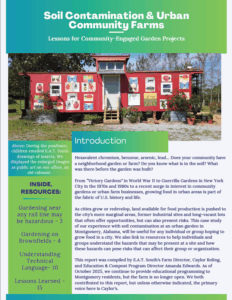
Soil Contamination & Urban Community Farms
The community leaders’ (Caylor Roling and Amanda Edwards) careful documentation, persistence, commitment to evidence, and avoidance of hyperbole in the face of obfuscation, dishonesty and endangerment of their employment and health has been inspiring to say the least. They describe their experience of overlapping but also absent jurisdictions of control and responsibility for environmental contamination and its remediation. The E.A.T. South farm story points to systemic problems for maintaining public health and safety that all community groups active in urban agriculture need to be attentive to. In documenting this story with care and a relatable personal voice they have created a resource for any other community groups currently producing food in urban areas, or considering doing so.
This project started with the intent to expand the already large positive community impact being made by the E.A.T. South urban farm in Montgomery, AL. From 2012 through early 2024 that farm provided multiple benefits to the people of Montgomery including creating a valued and beautiful downtown green space, educational opportunities and a chance to be in nature to over 10,600 children and 6000 workshop participants, donations of over 6500 lbs of fresh produce and farm eggs to city food pantries from 2020-2023, and was the setting for over 11,000 hours of volunteer service from 2016-2024 (see p 12 of the report).
Instead, the project documented a cautionary tale, in a sense chronicling how those benefits, and more, were lost.
The project resulted in the closure of the downtown farm in the interest of community safety. This is an important outcome that would not have happened without E.A.T. South’s collaboration with Thriving Earth Exchange. Without this project, we would still be exposed to all of the risks and hazards at the downtown farm site.
E.A.T. South is continuing this project through testing soils at other garden sites. Using funds provided by Thriving Earth Exchange, E.A.T. South is sending soil samples to labs for heavy metals analysis. The project team does not have a lab that will do chemical analysis. Initial samples have already found high concentrations of arsenic in one proposed farm site.
Acknowledgements
For their guidance and support we thank:
Environmental Protection Network (EPN), Sierra Taliaferro, Michelle Roos; Capacity Collaborative, Kathleen Kirkpatrick; International City/County Management Association (ICMA), Chris Harrell; Center for Creative Land Recycling (CCMR), Tamara Cardona-Marek, Claire Weston; Thriving Earth Exchange (TEX), Britt Forsberg, Julia Jeanty, Shari Rose.
Descripción
Acerca de la Comunidad
Community gardens in urban areas can be a project of grassroots efforts, of schools, medical centers, municipal, religious, non-profit or other groups. Often these groups have limited resources, yet at the same time partner with populations that might be particularly vulnerable to contaminants in the environment and/or food including children, youth, seniors, or others with compromised physical and emotional health.
E.A.T. South is a small nonprofit that works in partnership with Montgomery Parks and Recreation to deliver garden-based education programs for all ages. Since 2016, staff at E.A.T. South built a community around the farm of people from many walks of life – former and active duty military, retirees, survivors of traumatic injuries, college interns, formerly incarcerated people, stay-at-home moms, IT professionals, and others came together to learn about gardening and produce food for area food pantries.
Beyond the food produced, the farm connected people and held meaning for many. One volunteer remarked that the farm was the one place in Montgomery they met people who did not share their background or experiences. Another remarked that it was a place where they began to heal from trauma.
All E.A.T. South food gardens were grown in raised beds separated by barriers from the original soil because the staff were aware of arsenic contamination due to the site’s historic use as a railroad switching yard. Their original citizen science project proposed to Thriving Earth Exchange focused on testing and mapping arsenic contamination. Staff wanted to plant an in-ground food forest, and needed additional information to do so safely. The goal of mapping was to answer the question: Are there areas with less contamination that are suitable for the food forest plantings? And if so, where are these more suitable areas?
To initiate the TEX- E.A.T. South partnership, garden staff tried to obtain any relevant background information for the site. At the end of 2023, background research located the original 2010 soil assessment conducted by the Alabama Department of Environmental Management (ADEM) to prepare for establishing the garden. From this 2010 assessment, E.A.T. South staff learned the farm property was more contaminated than was previously shared with them. In addition to very high levels of arsenic, that assessment found that the soil contains excessive levels of chromium and more than ten cancer-causing chemicals.
We learned that the capacities and responsibilities for safeguarding community gardens like E.A.T. South from contamination is difficult to identify and activate across community, nonprofit, city, state, region and federal entities. E.A.T. South spent 2024 struggling to understand more about the site’s contamination; the extent of any remediation; the risks to staff, volunteer, and community health; and potential next steps. Since 2016, one staff member and two volunteers received cancer diagnosis. At the same time, staff began to notice at least 100 open coal rail cars passing the farm daily. Ultimately, staff decided to close the farm to keep the community safe from past and present environmental contaminants.
The farm’s closure was a loss to many in Montgomery. The farm grew close to a ton of vegetables a year that were shared with area food pantries. The space was a park where families brought children to feed chickens, and schools brought children annually for field trips. Regular volunteers lost their space for learning, socializing, and building relationships across Montgomery’s communities. The community also lost a space where families gathered for reunions, people mourned the loss of loved ones, and community organizations held celebrations like Family Pride Day.
For staff, the farm’s closure upended years of work building successful educational and volunteer programs. It also made fundraising nearly impossible.
Building on the experience of E.A.T. South staff and the TEX team that supported their learning and decision making the project described here will provide information that may prevent future gardens from being sited on contaminated land, offering the story of our experience to help others struggling with similar problems, and suggesting groups and resources that can help communities understand their situation and make plans to change it.
Sobre el proyecto
Community gardening in urban areas is increasingly appreciated for its many potential benefits: access to nature and fresh produce, opportunities for physical activity and social interaction, and stress relief. Yet space suitable for gardening is difficult to find ; gardens may not be a part of urban planning, and there is strong market competition for open space. This can mean that sites available for gardens are unsuitable or undesirable spaces, including spaces associated with present or past industrial or other uses and environmental contamination.
Despite potential for contamination, there may be little to no information available to community garden groups regarding which environmental risks and hazards they should look for, who is responsible for scientific testing for such hazards, what are sampling and testing procedures necessary for appropriate and credible results, who can help interpret results, and who is responsible for acting on those findings.
The project team’s experience in the last year with E.A.T. South in Montgomery, AL, will provide a documented example of the challenges faced by one garden with multiple reasons for wanting more information about the hazards present at a site and from the food grown there. This project will provide examples of parties responsible for different forms of assessment and oversight from the federal to local levels and of organizations and forms of expertise that can provide support to community garden groups.
The report will include documents, images, and testing results, comments or advice from experts who have been supportive in this process, and the project team’s and other community members’ reflections on this experience and lessons learned.
For other organizations or communities interested in the multiple benefits of urban food growing, this project would serve as a guide for replicating these efforts. Through the example of our experience and with information sourced with the support of TEX volunteers, this project will offer other urban gardeners ideas of appropriate questions to consider, how to find additional information about the land, and resources that exist to help community groups ensure the safety of our gardens and gardeners.
Equipo del proyecto
Líderes comunitarios

Caylor Roling is E.A.T. South’s Farm Director. With twenty years of experience in urban farming and community organizing, she teaches gardening classes for all ages, grows plants for school and community gardens, and harvests food for food pantries.
She is also a breast cancer survivor and wonders if exposure to chemicals at E.A.T. South contributed to her illness.

Amanda Edwards is an urban farmer and Director of Composting at E.A.T. South. She brings years of experience, having worked for market farms and farm-to-table restaurants in the area. She is passionate about building community and teaching others about the wonders of compost and soil life. Her favorite thing to do is build compost piles around the farm through the Community Compost Program.
Becario científico comunitario
Daniela Soleri – As an ethnoecologist my research uses methods from social and biological sciences to document and investigate people’s knowledge and management of their crop plants and foods. In different ways, this research asks: Through respectful collaboration, how can researchers support communities’ own efforts to construct food systems that reflect valued food and cultural traditions while adapting to 21st century challenges including growing social inequity, agrobiodiversity loss, high prevalence of diet-related noncommunicable diseases, migration, and the climate crisis? More here: https://people.geog.ucsb.edu/~soleri/
Collaborating Organizations
E.A.T. South is a small nonprofit that works in partnership with Montgomery Parks and Recreation to deliver garden-based education programs for all ages. Since 2016, the small staff at E.A.T. South built a community around the farm of people from many walks of life – former and active duty military, retirees, survivors of traumatic injuries, college interns, formerly incarcerated people, stay-at-home moms, IT professionals, and others came together to learn about gardening and produce food for area food pantries.
Status:
Complete,
Location:
Montgomery,
Managing Organizations:
Capacity Collaborative,
Project Categories:
Agriculture,
Community Garden,
Contamination/pollution,
Project Tags:
No tags