
Beneath the Surface: Sustainable Solutions for Culvert Challenges and Water Management in a Community Garden
Parrish, Alabama, United States
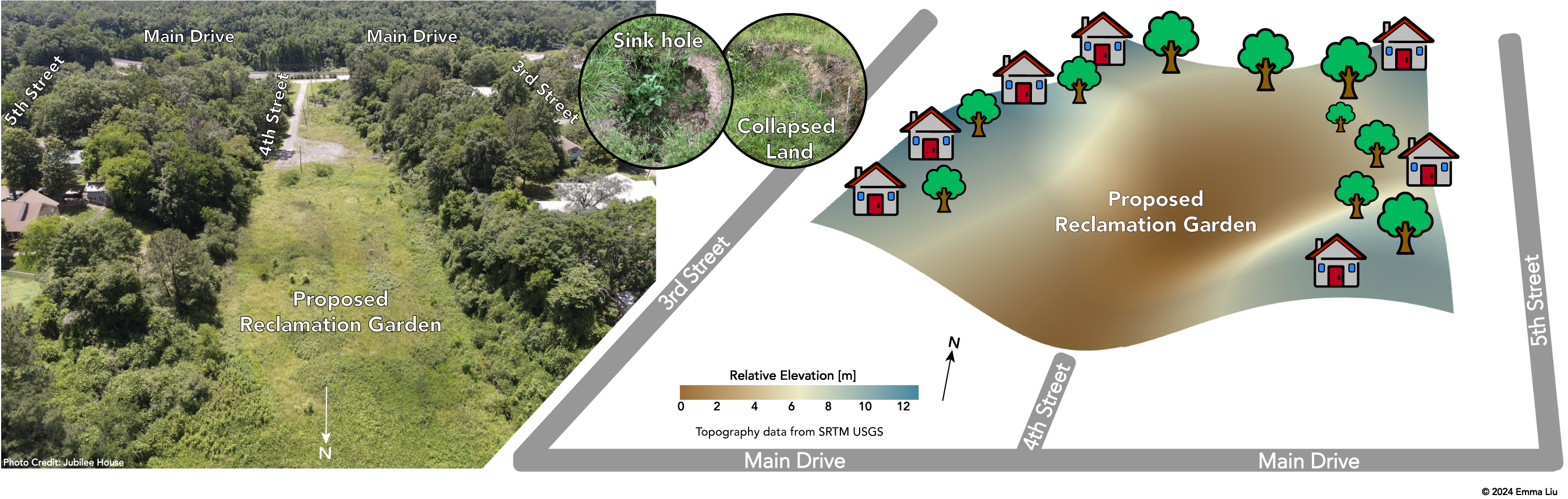
The Reclamation Garden in Jubilee House organization in Parrish, Alabama, which is designed to produce agricultural goods for local consumption, is currently facing a critical issue due to neglected culvert systems that lead to sinkholes, excessive water runoff, and subsequent land collapses. Through this project, we aim to accurately map the existing culvert infrastructure, assess its condition, and formulate a comprehensive management plan to handle water and culvert systems sustainably.
Resultados
Resumen del proyecto
The Jubilee House Reclamation Garden in Parrish, Alabama is a community-led initiative designed to transform a former high-school football field into a productive garden and educational green space. Jubilee House, founded in partnership with the Town of Parrish, strives to promote regenerative agriculture, food sovereignty, and community engagement. However, in 2023, the discovery of major sinkholes halted all garden activity. These sinkholes were later traced to a long-neglected stormwater culvert system running beneath the garden site.
This project aimed to identify the cause of repeated land collapses, map and assess the aging culvert infrastructure, and develop a path forward for safe restoration and long-term stormwater resilience.
To accomplish this, we have brought on board university scientists and engineers including Prof. Jack Montgomery, Prof. Mike Perez, Prof. Wesley Donald (all from Auburn University), and technical specialists from Video Industrial. Together, we have conducted following investigations that have identified the culvert issues, and will lay a solid foundation for the upcoming restoration.
Activities Conducted
- October 24, 2024 First Site Visit:
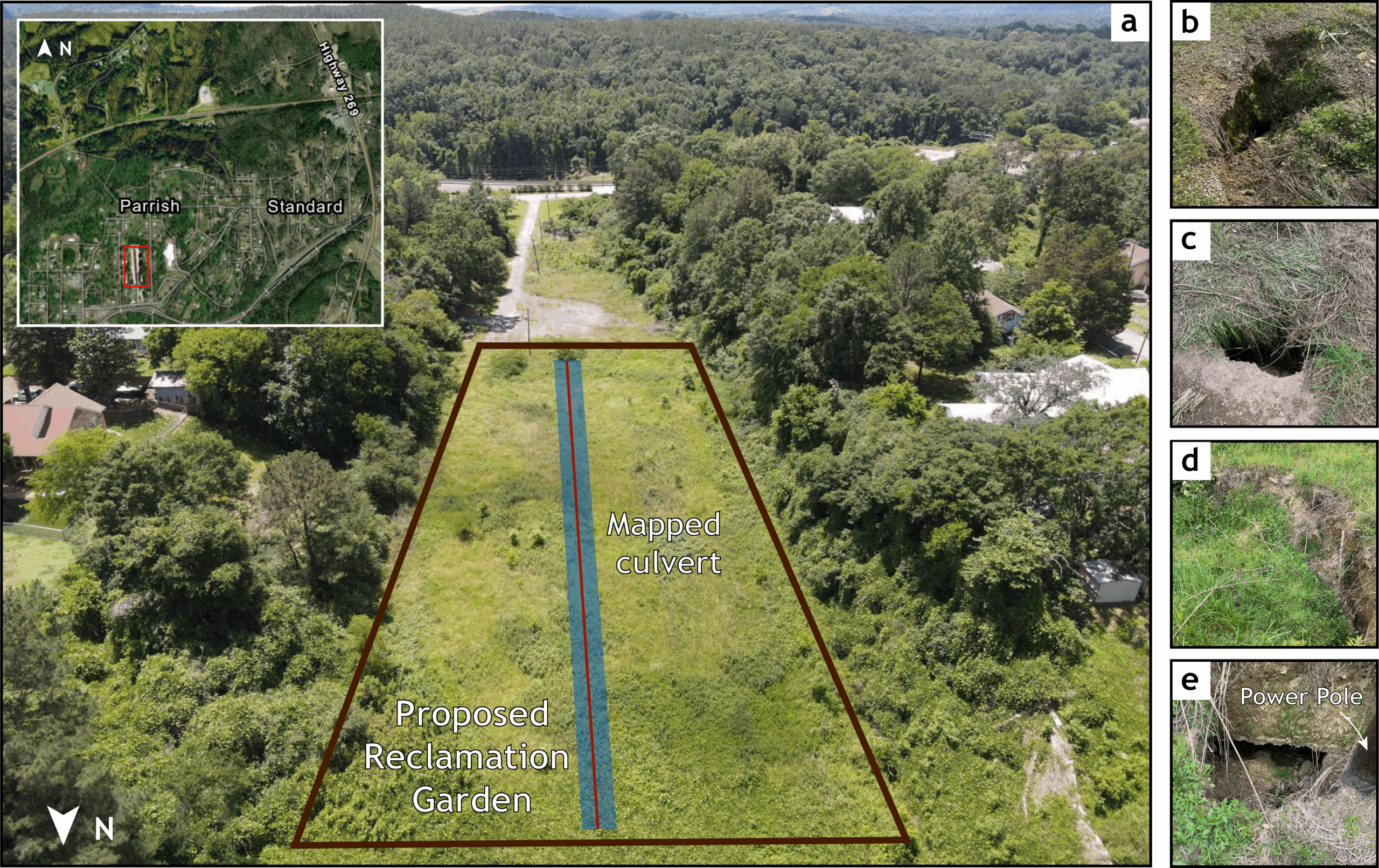
Prof. Jack Montgomery and his team arrived at the site in Parrish from Auburn University. They conducted the first field investigation, including drone mapping, elevation documentation, and measurement of multiple sinkholes. Using ground and aerial data, the team produced the first draft culvert map and identified three major subsidence zones. - May 12, 2025 Robotic Video Inspection:
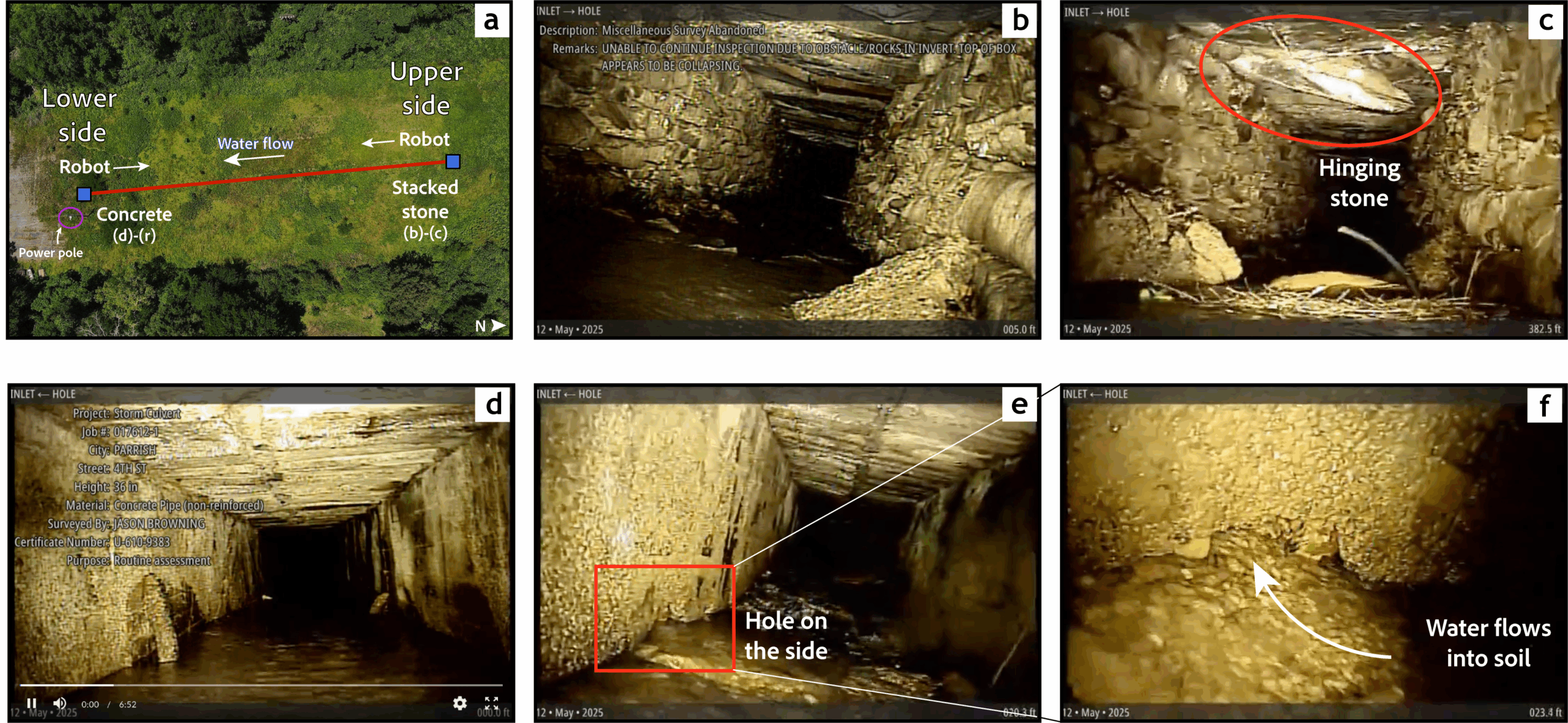
Video Industrial, a professional environmental infrastructure maintenance company, conducted a robotic camera survey from both culvert ends. Footage revealed two construction sections (stacked-stone and concrete), active water flow, internal wall voids, and structural failures correlating directly with observed surface sinkholes. - Nov 21, 2025 Site Visit:
Prof. Jack Montgomery, Prof. Mike Perez, Prof. Wesley Donald visited the site to determine the eligibility of this program participating in the stormwater facilities program funded by Alabama Department of Environmental Management (ADEM). The team believes this Parrish project is eligible and plan to pitch the project to ADEM.
Resultados del proyecto
Technical & Field Outputs
- Culvert Map (Oct 2024) – First GIS-based map identifying culvert route and three major sinkhole zones.
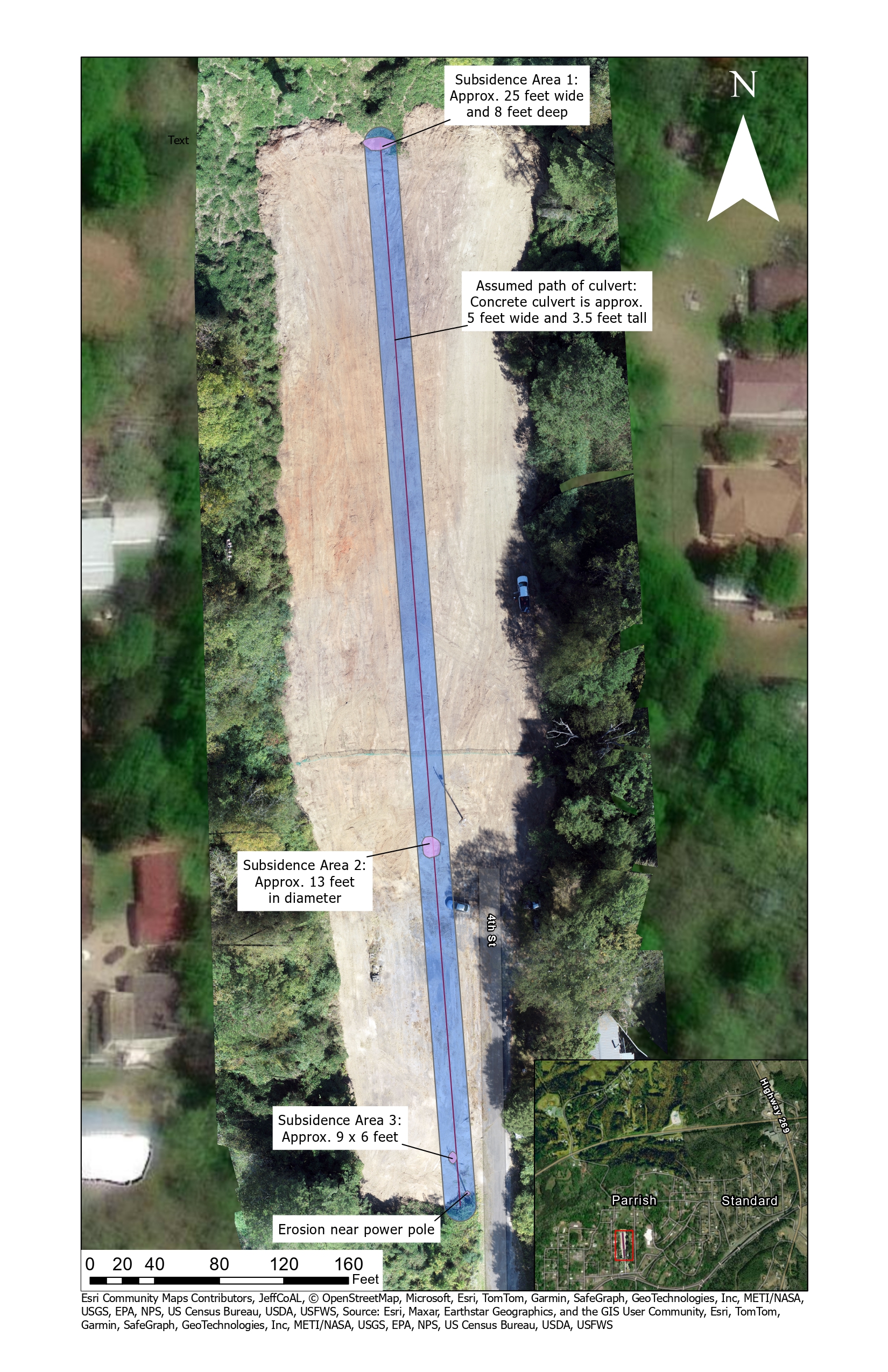
- Drone Survey Imagery & Site Map – Aerial and terrain interpretation of the garden property.
- Robotic Camera Inspection Video (May 2025) – Documentation of internal culvert condition, including stacked-stone and concrete sections, voids, and active erosion pathways.
- Engineering Assessment Notes – Interpretation of culvert construction phases, failure mechanisms, and replacement needs.
Community & Public-Facing Outputs
- News Article:
“Fight for It to Be Better” – Southern Science (Nov 13, 2024)
https://southern-science.com/2024/11/13/fight-for-it-to-be-better/ - AGU Documentary Film:
“Parrish Stormwater Story” (YouTube)
https://www.youtube.com/watch?v=UD_CZeeeYs4 - Photographic Catalog – Documentation of sinkholes, erosion sites, and culvert entrance conditions.
- Project Progress Report – Parrish AL Progress Report
Community Impact
Short-Term Impacts
- Provided Jubilee House with the first accurate map of the hidden culvert system beneath the garden.
- Identified structural failures posing risks to the property.
- Equipped the community with data needed to pause unsafe operations and plan for remediation.
- Enabled community leadership to communicate effectively with municipal, academic, and engineering partners.
Long-Term Impacts
- Established the technical basis for a full culvert replacement, a foundational step toward restoring the Reclamation Garden.
- Positioned Parrish to pursue stormwater infrastructure funding and expert engineering support.
- Raised broader visibility of the community’s stormwater challenges through media and academic outreach.
- Contributed to building a sustainable food system in Parrish by making future garden development safer and more resilient.
Acknowledgements
We thank the following individuals and organizations for their contributions:
- Jubilee House, especially community leaders Ryan and Jordan Cagle and volunteers who initiated and supported the project.
- Emma Liu, for serving as project manager, leading and managing the project from start to finish.
- Kathleen Kirkpatrick, for constant participation at all stages of the project, reviewing the draft and all paper work.
- Prof. Jack Montgomery, for field leadership, engineering guidance, and stormwater facility evaluation.
- Video Industrial for conducting the robotic camera inspection.
- Thriving Earth Exchange, Neighborhood & Community Funds, Take It Further Grant, and the Documentary Production Fund for project funding.
- Southern Science and community filmmakers for amplifying the story through journalism and documentary media.
Future Plans
Work is expected to continue into 2025–26. Next planned steps include:
- Conducting a hydrology assessment to determine proper culvert sizing and future stormwater management needs.
- Participating in a follow-up engineering and stormwater facilities evaluation
- Preparing grant application for federal stormwater infrastructure support
With ongoing support from university experts, community volunteers, and potential federal funding, this project is on track to restore the site and advance Parrish’s long-term goals for environmental resilience and community agriculture.
Descripción
Acerca de la Comunidad
Parrish is a small town in Alabama with a population of around 1,000. The town once thrived on extractive industries like coal mining and coal-fueled electrical generation. However, in recent years, these industries have left town, resulting in deteriorating and unmaintained infrastructure, environmental pollution, and economic decline. Additionally, the community faces frequent and worsening storm events and food insecurity. These combined socio-economic and environmental challenges threaten the health and well-being of the residents.
In response to these issues, Jubilee House was established two years ago in partnership with the Town of Parrish. The primary initiative of Jubilee House is the Reclamation Garden (“The Garden”). The goal of The Garden is to transform vacant land in the town into a community farm, promoting regenerative agricultural practices, food production, and community learning and play spaces. The Garden aims to provide locally grown food to combat food apartheid while fostering social, economic, and environmental benefits for the mutual flourishing of the people in Parrish and the surrounding communities.
Issues Facing the Reclamation Garden
The proposed site for the Garden is situated on a former football field (see Figure 1) associated with a closed down high school. This area lies in a basin surrounded by several houses and trees, with a vertical distance of about 10 meters (33 feet) between the bottom and the top. The initial plan was to establish a community garden at the front end of the property (near Main Drive) while gradually developing the larger sections of the overall farm project.
However, when planting began in 2023, a major sinkhole was discovered on the garden land, revealing a long-neglected culvert system beneath the surface. These culverts are concrete and likely for stormwater management for the basin and surrounding community. They are not currently maintained by any individuals or organizations. The pipes within these culverts are buried at varying depths, ranging from less than 1 foot to several feet underground. Consequently, The Garden project had to be halted due to several issues.
Problems:
- The unmaintained and old culvert system has caused the land to collapse, creating numerous sinkholes and collapsed areas (see Figure 1).
- The function and importance of this culvert system to the town’s larger storm sewer system are largely unknown.
- The Garden is located in a basin that turns into water pools and swamp during the rainy season, causing excess water to run off to Main Drive and result in flooding.
Sobre el proyecto
The goal of this Thriving Earth project is to prepare the property for restarting The Garden Project and begin cultivating agricultural goods. To achieve this, we propose the following
Scope:
- Data Collection: Detect and document the underground culvert system near The Garden and create a comprehensive map. This will include the locations and depths of the pipes, nearby pumping stations (if any), their connections to other sewer lines (if any), and any relevant information about their condition and capacity.
- Data Analysis: Assess the condition of the current culvert system to determine if it is safe to remove, replace or repair the pipes.
- Model Simulation: Combine all collected data (culvert system map, topography, land use, and precipitation data) to identify the least damaging method to remove or replace or repair the culverts using model simulation. In addition, develop a sustainable management plan for The Garden, potentially using runoff water for irrigation.
The final outputs of the project will depend on the progress and results from the data collection stage.
Salidas:
- Map of Culvert System: Produce an up-to-date map and manual, and photos of the culvert system near The Garden for current and future reference.
- Culvert Removal/Replacement/Repairment Plan: Develop a plan based on a comprehensive analysis that includes culvert inspection, land use evaluation, land damage modeling and monitoring, and consideration of legal and local community restrictions.
- Culvert Management Plan: Create a detailed plan for culvert maintenance and inspection if the decision is made to replace the culvert.
- Garden Management Plan: Develop an irrigation and management plan to utilize precipitation water for irrigation and mitigate flooding.
Calendario e hitos
The project has a baseline length of 12 months, with possible extension up to 18 months. The priority is to map the current culvert system (Scope 1 and Output 1) by the end of 2024. The timeline for the remaining scopes and outputs can be discussed upon the onboarding of the scientist(s).
Equipo del proyecto
Líderes comunitarios

Ryan Cagle is a self described trailer trash pentecostal theologian with a proclivity for liberative political praxis living in the backwoods of Alabama. He has served in a myriad of church contexts over his 13 years in ministry and is a trained spiritual director who uses table-top role playing games to cultivate space for personal and spiritual discovery. Ryan attends United Theological Seminary where he is pursuing both a Masters of Divinity in Social Transformation and a Masters of Art in Ecological Justice exploring the intersections of food, farming, and faith. Ryan is one of the co-organizers of Jubilee House Community.
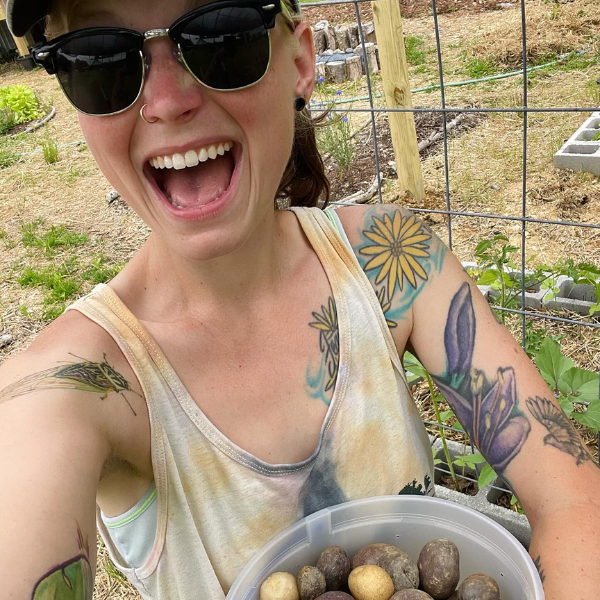
Jordan Cagle spends her time homeschooling two wild children and tending to the community garden. Her love language is food. Cooking for a whole slew of family and friends is a weekly occurrence at the Cagle house. She is also a musician and plays multiple instruments and enjoys singing all sorts of music, from rock and roll to Disney. She is happiest outside, particularly hiking, no matter the weather or terrain. You will often find her flipping things over to admire small creatures and sometimes pick them up and love them too. She really enjoys a good project and getting her hands dirty learning a new skill. Jordan is one of the co-organizers of Jubilee House Community and is passionate about helping those in her community who need it the most.
Científico comunitario

Jack Montgomery is an associate professor at Auburn University in the Department of Civil and Environmental Engineering. His research and teaching focuses on understanding how geotechnical systems respond to natural hazards, including landslides, precipitation, sinkholes, and earthquakes. His work has been supported by the National Science Foundation, Nuclear Regulatory Commission, Alabama Department of Transportation, and the US Army Corps of Engineers.
Becario científico comunitario

Emma Liu is currently a PhD in Geophysics at Stanford University. Prior to her PhD, she studied aerospace engineering at Stanford with a focus on computational fluid dynamics. Her research interests lie primarily in developing numerical models to study glacier dynamics. Recently, her research interests expand to incorporating machine learning to understand the multi-scale behavior of ice. A large portion of her research utilizes remote sensing data in the polar regions. Apart from research, she is also passionate about women in science in general. She serves as the co-chair of the Association of Women in Science (AWIS) Stanford/Palo Alto chapter.
Collaborating Organizations

Jubilee House Community is a non-profit organization run by Ryan and Jordan Cagle built on the principles of mutual aid and solidarity. Jubilee started three years ago with the launch of the People’s Pantry in partnership with the Town of Parrish. The People’s Pantry exists as an alternative model for responding to the rampant food insecurity in our community by not only providing 24/7 access to thousands of dollars of groceries a year to our community with no barriers, but also by inviting our neighbors into contributing to help make sure those hungry have access to food. Jubilee does not operate on the traditional “charity” model at the core of most related nonprofit and ministry related organizations, and instead operates on a model of “solidarity” seeking to combat the issues in our community as/with those who suffer rather than as outsiders whose lives are not bound up in those same struggles. Since the launch of the People’s Pantry Jubilee House has launched several other initiatives such as a community garden, a free store, Project H.E.R.O. (Healing Emergency Response to Overdose), and other mutual aid projects that seek to address poverty, environmental injustice, homelessness, and harm reduction needs in our community.
Status:
Complete,
Location:
Parrish,
Managing Organizations:
Capacity Collaborative,
Thriving Earth Exchange,
Project Categories:
Sustainability,
Water Management,
Project Tags:
No tags