
Assessing Air Quality Impacts on an Underserved Neighborhood in St. Louis
St. Louis, Missouri, United States
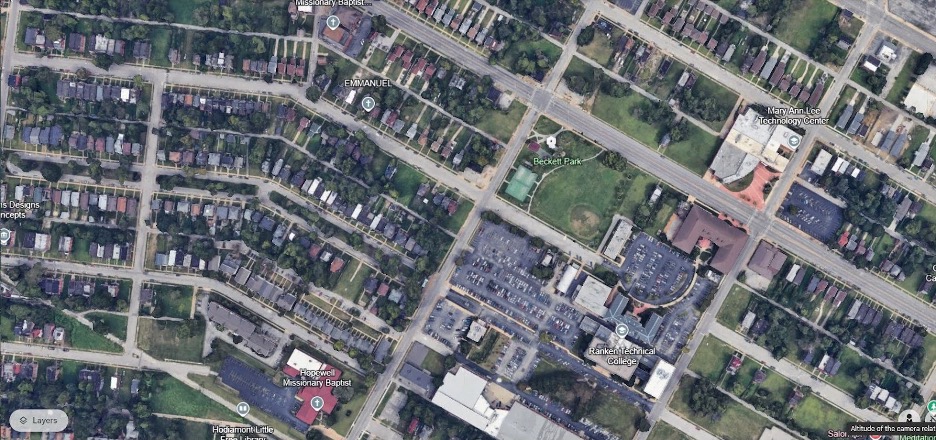
The Lewis Place neighborhood in St. Louis, Missouri, is an underserved, predominantly Black community facing significant environmental challenges due to redlining, industrial development, and abandoned properties. This project seeks to assess and monitor air quality as the neighborhood experiences continued impacts from industrialization. By involving residents, particularly youth, in sustainability efforts, the project aims to foster environmental awareness, identify critical areas of concern, and empower the community to advocate for healthier living conditions.
Results
Project Summary
Lewis Place is a historic neighborhood in St. Louis, Missouri, where the project team conducted an air monitoring study. Most residents are Black (84%), and the population is 1,359. The community has historically faced challenges from redlining and disinvestment. Homes were built in this community in the 1890s to 1930s, when environmental toxins such as lead and asbestos were in use and industry and homes were built in the same area without regard for potential harm.
The community continues to be affected by emissions from nearby industrial plants and automobile traffic. Additionally, plans for an advanced manufacturing and innovation center (AMIC) could increase air pollution if appropriate safeguards are not put in place. The community’s primary goal is to preserve their historic community, protect its housing and cultural heritage, and ensure a healthy environment for residents. The air monitoring project aims to raise awareness about air quality, prevent additional harm from pollution, and ultimately improve the well-being of everyone who lives here.
Together, the community and Thriving Earth Exchange planned the project, set parameters, and evaluated the activities. The project team received a small grant to purchase a Purple Air monitoring device, contracted an IT technician to set up online access, and to compensate a neighbor for 24/7 use of electricity and internet. The monitor was mounted on a building near the community garden and is collecting air quality data around the clock. The project team has been able to access this information in real time, allowing for continuous monitoring and timely responses to changes in air quality.
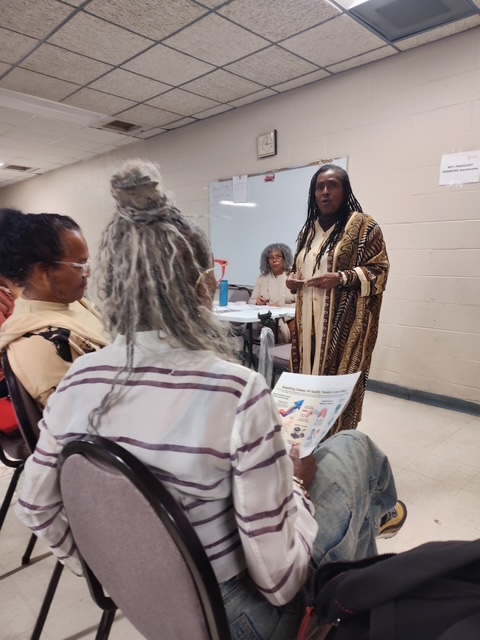
In November, the project team presented the project results at community meetings, providing a 9-page report to approximate 40 people. During the February meeting with 65 people, an infographic was provided with the presentation on the project and its results.
Project Outputs:
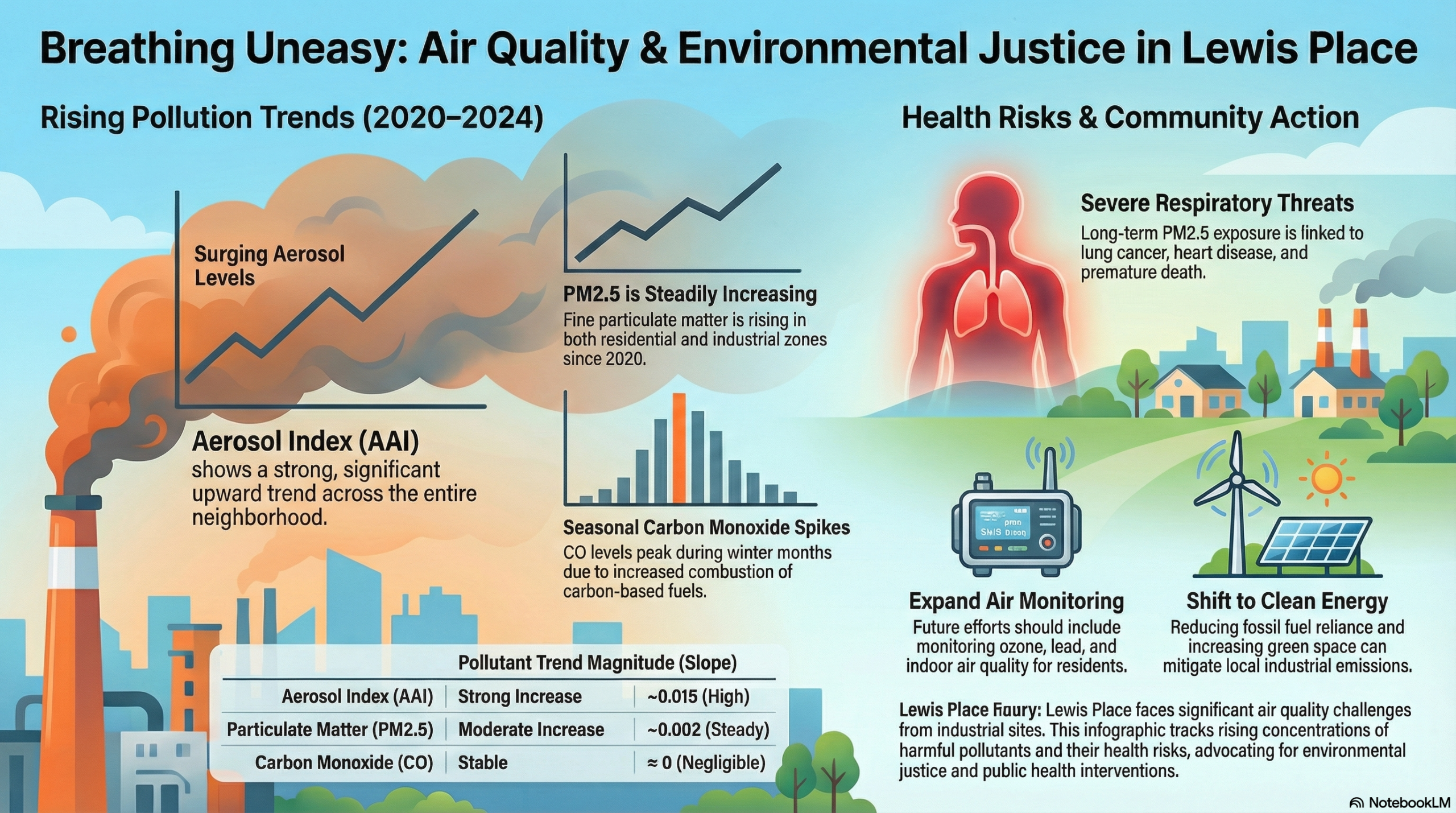
- An analytical and technical report by the project’s volunteer scientist that has provided us with a baseline understanding of the local air quality prior building and opening of the advanced manufacturing and innovation center, seasonal trends in air quality, and information as to how the community can help to mitigate some of the harmful effects of poor air quality
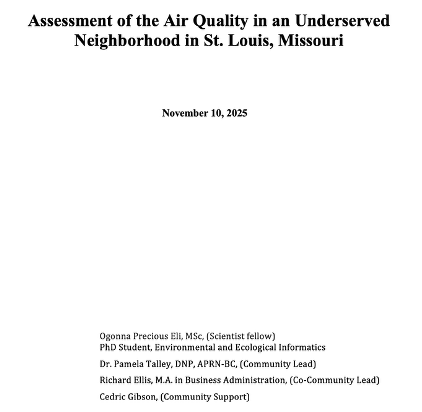
- An infographic on air quality trends in Lewis Place
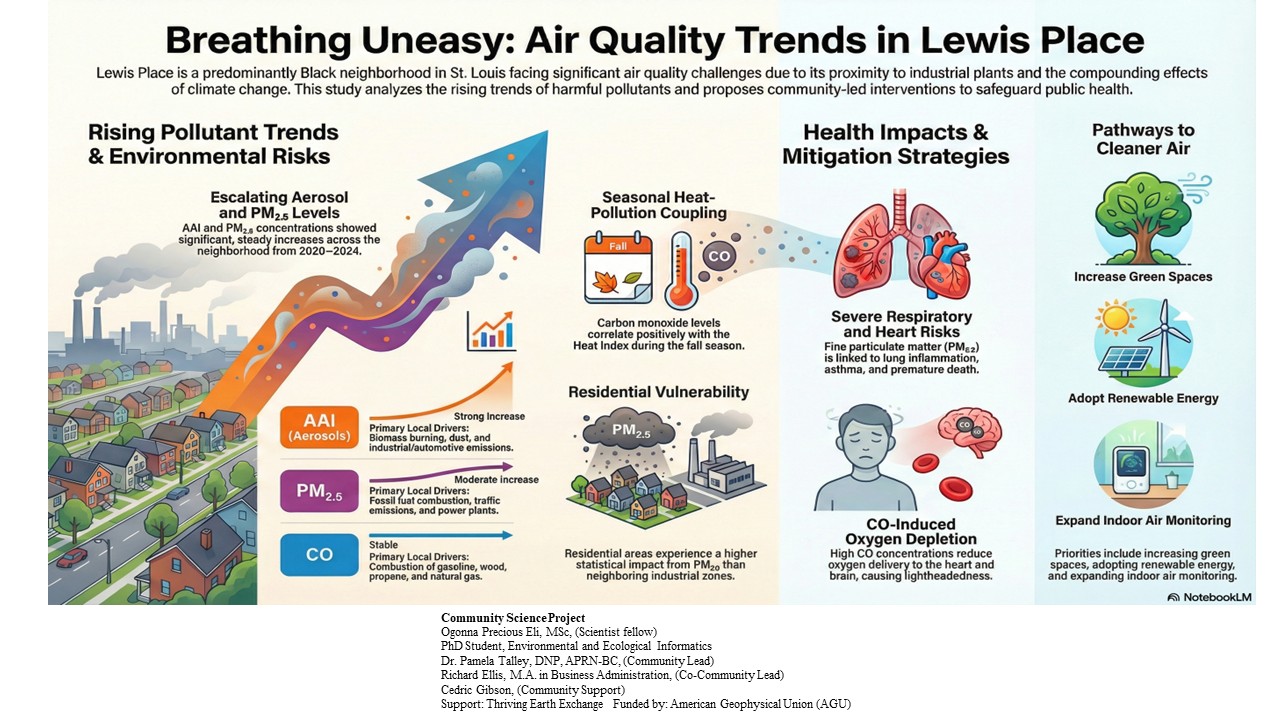
- Community presentations
Community Impact
The community is now more aware of the harmful effects of the air we breathe and is increasingly concerned about air quality. As a result, residents are actively seeking ways to reduce exposure to pollutants and are participating in ongoing discussions about community health and safety.
Acknowledgements
Ogonna Precious Eli, MSc, (Volunteer Scientist), PhD Student, Environmental and Ecological Informatics
Dr. Pamela Talley, DNP, APRN-BC, (Community Lead)
Richard Ellis, M.A. in Business Administration, (Co-Community Lead)
Cedric Gibson, (Community Support)
Future Plans
The community is seeking ways to continue monitoring local air quality. They are currently talking with a local university and laboratory about opportunities for continuing this work.
Description
About the Community
Lewis Place is an underserved, predominantly African-American neighborhood in St. Louis. Historically impacted by redlining, the community struggles with environmental justice issues, including poor air quality, lead poisoning, and asbestos contamination. With many dilapidated properties and limited access to resources, the area is undergoing significant change due to increasing industrialization which raises concerns about increased air pollution.
Dr. Pamela Talley, Executive Director of Lewis Place Historical Preservation, Inc. and community leader for this project, has decades of experience in community health and youth engagement. Collaborating with a coalition of 13 churches, the community is dedicated to addressing these challenges. Despite political barriers that favor business over community needs, Lewis Place remains committed to improving environmental conditions and engaging youth in sustainable solutions.
About the Project
The community seeks to monitor local air quality to understand the environmental and health impacts of legacy and emergent air pollution. This data will guide actions to mitigate negative health outcomes and strengthen advocacy efforts for cleaner air as new industries are developing in the community. The project involves installing air monitoring equipment, training local residents in its use, and analyzing collected data to pinpoint major pollution sources.
The project will install air quality monitors, organize workshops for data interpretation and will engage in public discussions with local stakeholders. Local stakeholders include residents, youth, Americorp workers, churches. elected officials and the leadership of Lewis Place Historical Preservation. Educational sessions regarding air quality reports will increase local awareness about environmental health. Educational sessions regarding air quality reports will increase local awareness about environmental health. It will further improve the community’s understanding of environmental risk, provide actionable data for advocacy, and empower the community. The Lewis Place community can be a model for other underserved neighborhoods facing similar environmental challenges.
Timeline and Milestones
The project is expected to run for 18 months, with key milestones including equipment installation, initial data analysis , and a final report presentation .
- Finalize project scope
- Recruit and onboard a scientist
- Install air quality monitoring equipment
- Initial air quality data analysis
- Final report presentation to the public and the Department of Natural Resources
Project Team
Community Leaders

Pamela Talley is a doctoral-prepared nurse practitioner passionate about caring for individuals and families in their homes and communities. She has assisted with establishing community gardens and urban farms throughout St. Louis to address the lack of fresh fruits and vegetables in food deserts. Since 2009, Pamela has served as the President of the Lewis Place Historical Preservation, a non-profit community development corporation founded in 2000 to help save the historic community from the devastating consequences of redlining. Under her leadership, the board has established partnerships and collaborations to build an influential community.

Richard Ellis has extensive experience in commercial projects (educational environments, etc.), Multi-unit, sewers and water main inspections, and mixed-use housing; developing, monitoring, and implementing Health and Safety programs working as a team leader serving the community. Retired United States Army, Corps of Engineers.

Ojasi Kirtikar is an AmeriCorps Vista worker working as the Community Engagement and Sustainability Coordinator. She will be leading a youth climate resilience program to help build climate resilience in the neighborhoods. She is a recent graduate from North Carolina State University where she earned her bachelors of science degree in Environmental Sciences.
Community Scientist

Ogonna Eli Precious is a PhD student in Informatics and Computing at Northern Arizona University, specializing in Ecoinformatics. Her research explores plant responses to drought stress, integrating functional anatomy, ecophysiology, hyperspectral imaging, and geospatial analysis. She leverages remote sensing and spatial data to analyze climate change impacts and address public health disparities.
Collaborating Organizations
Lewis Place Historical Preservation, Inc.

Lewis Place Historical Preservation, Inc. is dedicated to preserving the cultural and environmental integrity of the Lewis Place neighborhood.
Anthropocene Alliance
Anthropocene Alliance (A2) has more than 370 member-communities in 54 U.S. states and territories. They are impacted by flooding, toxic waste, wildfires, and drought and heat — all compounded by reckless development and climate change. The consequence is broken lives and a ravaged environment.
The goal of A2 is to help communities fight back. We do that by providing them organizing support, scientific and technical guidance, and better access to foundation and government funding. Most of all, our work consists of listening to our frontline leaders. Their experience, research, and solidarity guide everything we do, and offer a path toward environmental and social justice.
Creation Justice Ministries

Partnering with faith communities to address sustainability and environmental health concerns.
Status:
Complete,
Location:
St. Louis,
Managing Organizations:
Anthropocene Alliance,
Creation Justice Ministries,
Thriving Earth Exchange,
Project Categories:
Air quality,
Community Engagement,
Contamination/pollution,
Environmental Justice,
Sustainability,
Project Tags:
No tags