Why Community Science Belongs at the AGU Annual Meeting
AGU’s annual meeting offers community science teams a welcoming forum to share their work, learn from others, and build meaningful connections
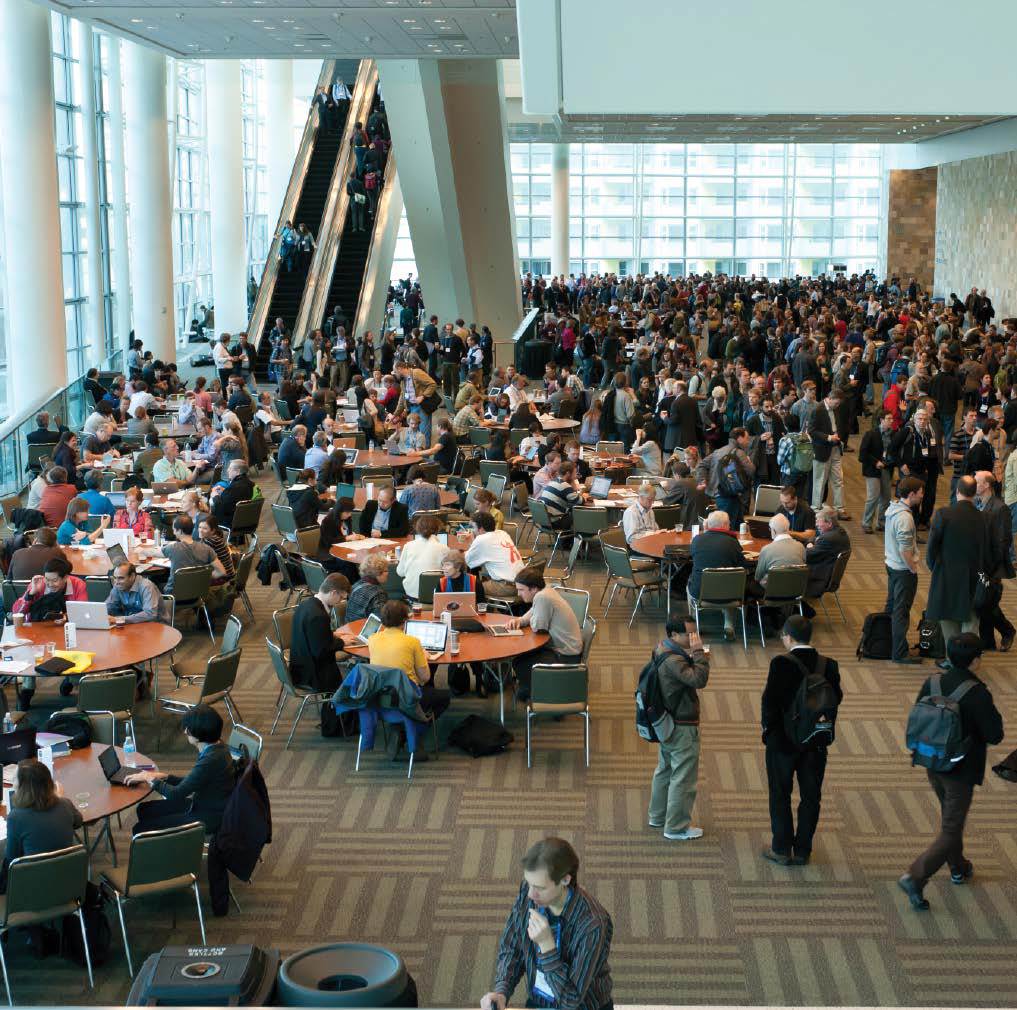
Convening thousands of researchers, students, educators, and policymakers each December, AGU’s Annual Meeting has long been known as one of the world’s largest scientific conferences. But increasingly, the meeting is also becoming a space for community leaders, nonprofit organizations, and others working at the intersection of science and society.
For community science teams, attending and presenting at AGU Annual Meetings can be both energizing and deeply affirming. With an inclusive vibe that goes beyond a traditional academic conference, the meeting is a place to elevate community-driven work, form new partnerships, and learn from others navigating similar challenges and opportunities.
Abstract submissions are now open for AGU26, to be held 7-11 December 2026 in San Francisco, California. With no-cost waivers available for community leaders covering both abstract submission and registration, we encourage everyone in the Thriving Earth network to join the conversation—and the fun!
Elevating community science within the geosciences
For many community science teams, one of the most valuable aspects of AGU Annual Meetings is the opportunity to showcase work that might not otherwise receive visibility within traditional scientific spaces.
Kate Semmens, Science Director and Grants Administrator for The Nurture Nature Center, has attended at least 15 AGU Annual Meetings. She says sharing community science work at the meeting helps demonstrate the value and impact of approaches rooted in collaboration and local knowledge.
“Attending and presenting at AGU is so valuable,” Semmens said. “You meet so many amazing people doing phenomenal work. It is a really uplifting experience—you see the value in the work you do as others express interest and want to learn more.”
Over the years, Semmens has seen AGU broaden the types of conversations and experiences represented at the meeting. One standout moment came when she helped coordinate an Art and Science plenary session in 2023 focused on immersive art and science communication. “I was blown away by the support that AGU gave for a plenary outside the normal straight science focus,” she said. “Standing on that huge stage and being afforded the opportunity to speak to the importance of integrating science and art was surreal.”
Building collaborations and expanding networks
The meeting’s scale can feel a tad overwhelming at first, but it also creates unique opportunities to make connections across sectors and disciplines. For community leaders seeking scientific partners, facilitators looking to exchange ideas, or researchers hoping to engage more meaningfully with communities, the meeting offers countless opportunities for conversation.
“It’s an opportunity to learn from others who’ve had similar experiences and connect with scientists who may be able to assist their communities,” said Kathleen Kirkpatrick, Southeast Manager at The Capacity Collaborative. At AGU.25, which was held in New Orleans, Kirkpatrick saw how meaningful those connections could be when local community members she had worked with were able to attend and share their experiences.
Semmens also emphasized the importance of the informal interactions that happen outside formal presentations. “I greatly value the one-on-one connections and side conversations with friends old and new,” she said. “It makes the AGU community feel like a place I belong—a large family connected around science and society.”
From poster halls and networking pods to section lunches and off-site events, AGU creates many opportunities for community science practitioners to find one another and build lasting relationships.
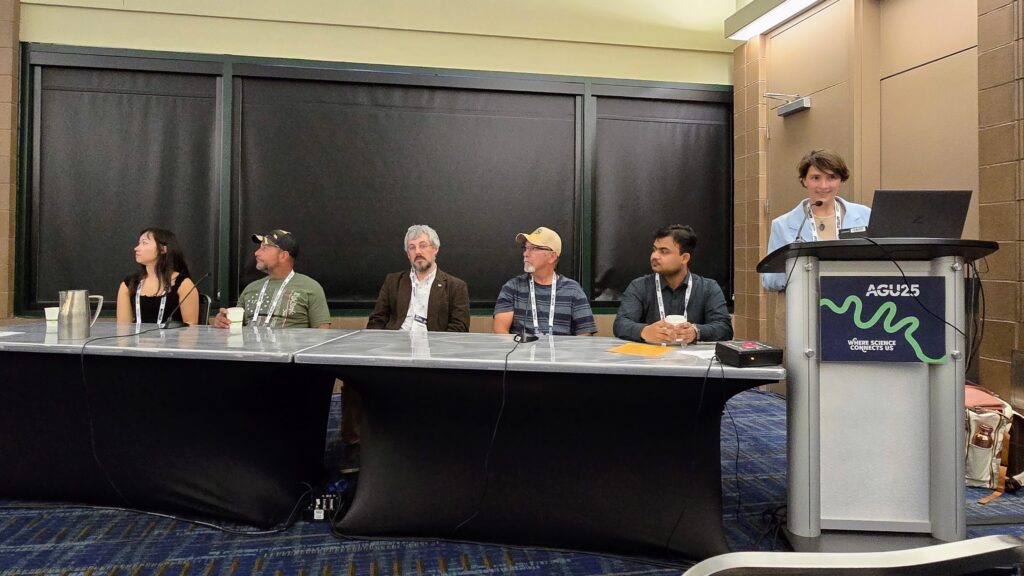
The Cameron, Louisiana project team presenting at AGU25
Learning from others and finding new resources
Beyond presenting, AGU can also serve as a learning environment for community science teams looking to strengthen their own projects and approaches. “You learn you are not alone in your quest to move community science forward,” Semmens said. “You discover resources, ideas, and connections that strengthen your resolve and work.”
Kirkpatrick encourages first-time attendees to explore beyond their own sessions and take advantage of the breadth of programming available. “Make time to connect with other community science practitioners in particular, but also check out the plenaries and poster sessions,” she said. “It’s a huge conference, so pace yourself!”
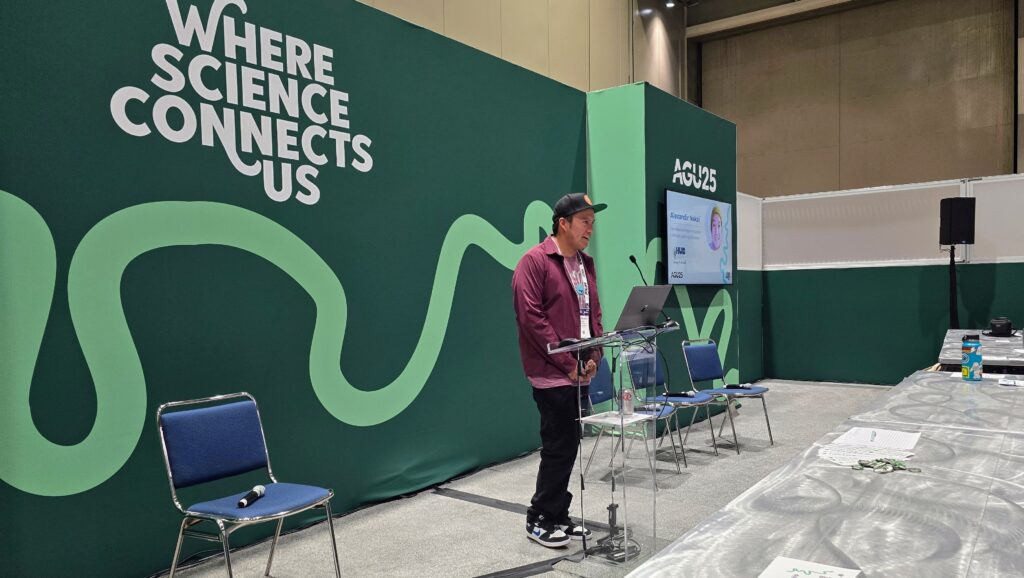
Both Semmens and Kirkpatrick note that AGU has expanded programming relevant to community science in recent years, including sessions designed specifically for collaborative and community-engaged work.
For those unsure whether their work belongs at AGU, Semmens offers simple advice: Go for it! “Without hesitation, submit an abstract and go,” she said. “You will come away enriched with new knowledge, inspired by new ideas, and supported with new connections.”
As AGU26 approaches, community science teams have an opportunity not only to participate in the meeting, but also to help shape the future of how science is practiced, communicated, and connected to communities.
The Thriving Earth Exchange team is here to support you! Reach out with any questions or simply to bounce ideas. We would love to welcome you to AGU26.
Non-scientists interested in representing their community’s interests in Earth and space sciences can apply for no-cost registration and an abstract fee waiver here.