Local Actions to Battle Rising Temperatures: a 5 Year Retrospective on Cambridge’s Fight Against Urban Heat Island Effect
by Julia Jeanty
Before becoming the AGU Thriving Earth Exchange Program Manager for Community Science Fellows, Julia Jeanty served as a volunteer Community Science Fellow on a project in Cambridge, Massachusetts. In the blog below, she reflects on her time as a Fellow, major takeaways from the project, and the importance of continued community science efforts related to urban heat.
Over the last 6 years, the U.S. has seen countless records being broken for extreme heat across the country. No corner of the U.S. is left unscathed from extreme heat, and many are questioning whose responsibility it is to keep people cool and protect those who live in cities from the negative impacts of rising temperatures.
Many communities, especially those in more historically temperate areas, do not have access to adequate cooling infrastructure because it was never previously necessary. With rising global temperatures, however, extreme heat is posing a threat to people and property alike, and without sufficient cooling infrastructure, the outcomes could be fatal. According to the World Health Organization, heat stress is the leading cause of weather-related deaths.
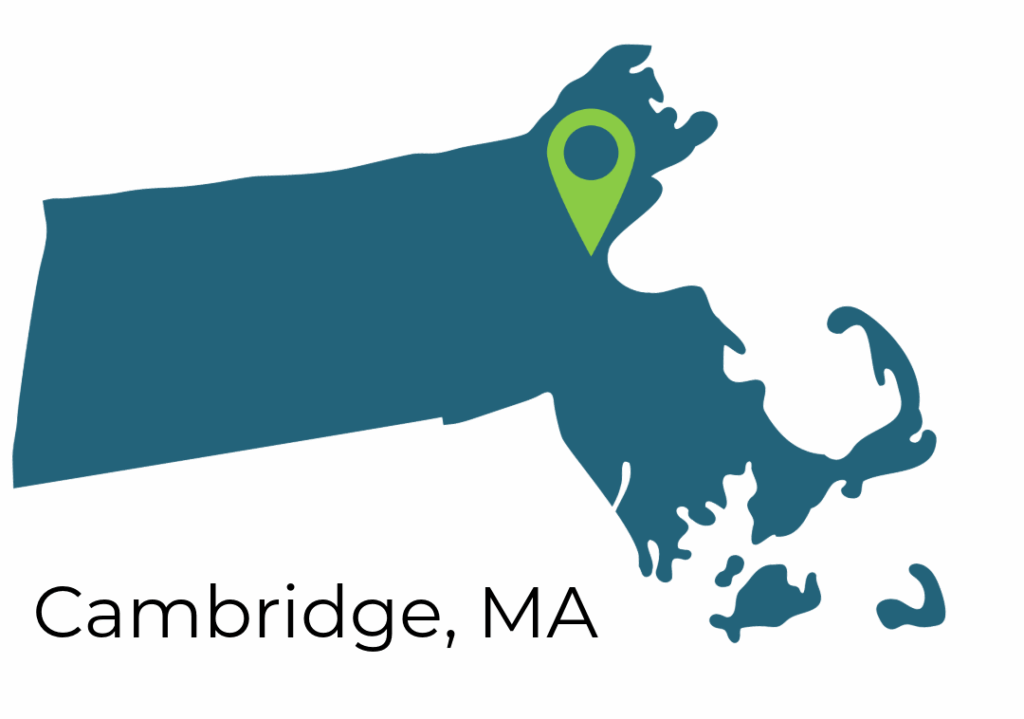
Cities like the City of Cambridge in Massachusetts have begun exploring opportunities to safeguard their community from the negative impacts of climate change by developing a citywide Climate Change Preparedness & Resilience (CCPR) Plan in order to help the city adapt to future rising temperatures.
The CCPR Plan focused on developing strategies to reduce the Urban Heat Island Effect, the phenomenon in which urban areas are hotter than adjacent suburban and rural areas. To ensure that the CCPR Plan was effective, the City developed metrics that can be tracked to guide and adjust implementation over time alongside the changing climate. In 2019, Cambridge was able to measure and track impervious surface area and urban forest canopy cover, but did not have the capability to track changes in rooftop albedo (surface reflectivity).
It was with this in mind that the City of Cambridge set out to partner with Thriving Earth Exchange to develop a methodology to track changes in albedo over time to enable evaluation of whether the City was successfully reducing the Urban Heat Island Effect.
The project team was composed of 2 community leaders working with the City of Cambridge, a Volunteer Scientist and urban planning and policy expert Mehdi Harris, a team of Volunteer Scientists from NASA DEVELOP, and me, Thriving Earth Exchange’s Community Science Fellow.
Project Outcomes and Impacts
The project resulted in the creation of a Python procedure that calculates albedo from two sources: National Agriculture Imagery Program (NAIP) and Ortho imageries (geometrically corrected aerial photos). The team created graphics to explain how each resource can be used for tracking change in the city. The team’s Github page provides the codes to run this procedure and visualize the results. This code was used to develop the following science communication materials to help explain the City’s changing albedo over time:
- Rooftop albedo maps showing rooftop albedo for three distinct years and the change in Cambridge rooftop albedo from 2008 to 2018
- A nighttime land surface temperature record for summers in Cambridge from 2003 and 2019
- Temperature anomaly maps for Cambridge compared to a portion of Eastern Massachusetts from 2004 to 2019
- The Cambridge Urban Heat ArcGIS Online Dashboard
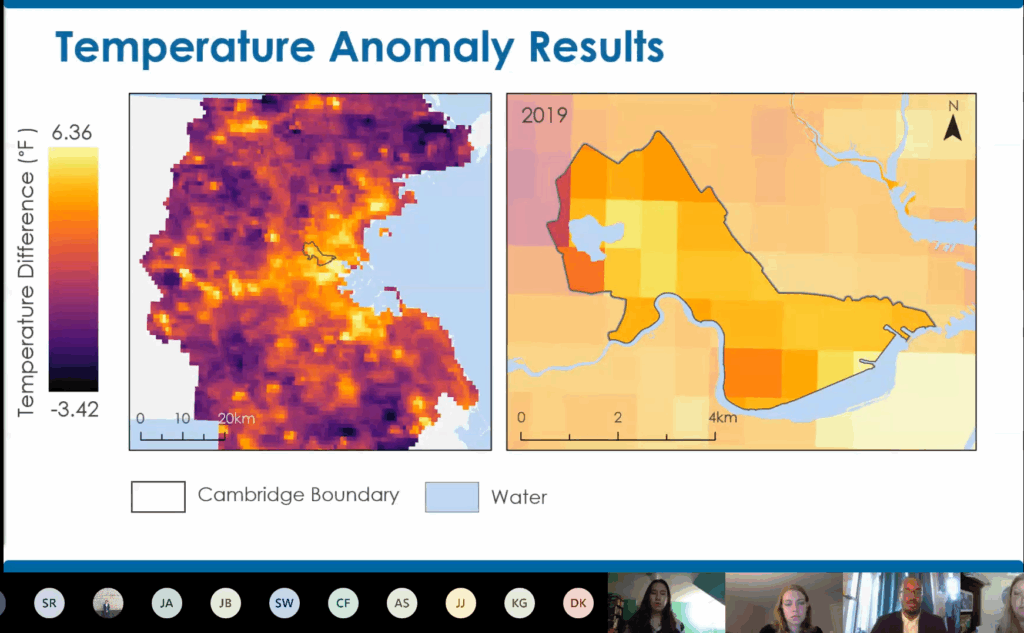
Additionally, the team presented on their work in 2 different NASA virtual events – the NASA DEVELOP closeout showcase and NASA Applied Sciences Week:
- Closeout Presentation, Cambridge Urban Development Project, NASA DEVELOP
- Cambridge Urban Development: Quantifying Changes in Urban Albedo with NASA Earth Observations to Reduce Urban Heat Island Effect in Cambridge, Massachusetts
The results of this work show that rooftop albedo has actually increased over time since 2010, pointing to the success of measures implemented by the City to reduce Urban Heat Island Effect.
Since the project has concluded, the City of Cambridge has developed a comprehensive Resilient Cambridge Plan that has dedicated storymaps on Heat Risk and Heat Strategies, which incorporate the work done with Thriving Earth Exchange.
In the face of an ever-warming global climate system, hyper-local and community-driven solutions can help mitigate some of the worst impacts of climate change.
Looking Ahead: Potential Solutions
As global temperatures have only continued to rise in the 5 years since the Cambridge Thriving Earth Exchange project was launched, it has never been more critical to implement local solutions to mitigate extreme heat and protect communities. Community- centered solutions can have wide-reaching benefits for reducing Urban Heat Island Effect and keeping community members safe and cool. Some of these solutions include:
- Increasing diversified hyperlocal measures that are proven to reduce urban heat in different areas, i.e.,
- Infrastructure Investments – splash pads, public pools, misting systems, cooling centers, and cool roofs and pavements
- Natural Climate Solutions – increasing urban tree canopies and access to public parks and green spaces
- Local Policy – AC mandates similar to heating mandates that require facilities like apartments, jails, schools, factories, etc. to cool buildings during summer months
- Creating resources that make extreme heat data accessible
- Heat-centered webpages and storymaps
- Social media posts about how to combat extreme heat
- Push notifications/texts when local heat-advisories are issued
- Investing in rapid response measures
- Emergency extreme heat declarations to allocate more resources to vulnerable communities
- Extended hours for public pools and cooling centers
- Protecting vulnerable communities
- Elderly communities
- Disabled and ill people
- Disenfranchised communities (low-income, low social-economic status communities, environmental justice communities)
- Getting community members engaged
- Make the issue well-known, like the Global Heat Health Information Network is doing through their extreme heat photo contest
- Have local “beat the heat” events like community pool parties
- Explore opportunities to do community science or citizen science projects related to extreme heat
Community science projects like the project in Cambridge are critical for taking incremental steps to address large scientific issues. By following Cambridge’s example, other communities can work to better keep people safe from extreme heat.