A Growing Community of Voices: Spanish-Language Inclusion at Thriving Earth Exchange
Bridging Language Gaps in Community Science

Language isn’t just a tool for communication—it’s a foundation for connection, collaboration, and trust. Two years ago, Thriving Earth Exchange embarked on a journey to make community science more inclusive by creating space for Spanish-speaking voices. To lead this work, we welcomed Marina Cox, our project coordinator for Spanish-speaking projects to lead this initiative. From the very beginning, Marina recognized that true inclusion would take more than simply translating materials. It meant building meaningful relationships, honoring and recognizing cultural and historical contexts, and listening to community needs.
Since then, what began as a dedicated effort to reduce language barriers has grown into a much larger story for global inclusion in community science, connecting communities, volunteer fellows, and scientists across borders and cultures. This work is a testament to the potential of science when inclusivity is built into its foundation.
Expanding Our Global Impact
Our commitment and strategy to language inclusion has allowed us to launch projects across multiple countries and communities—from the urban wetlands of Soacha, Colombia, where students are actively participating in wetland restoration, to the mountainous region of San José de Maipo, Chile, where communities are monitoring the water quality of the Maipo River.
The reach of this initiative extends even further:
- In Mexico, the rural community of Ejido Santa María is developing an Environmental Education Program for primary school teachers, students and their families. Through interactive activities and participatory research strategies, they are empowering the next generation to become agents of change on local environmental issues.
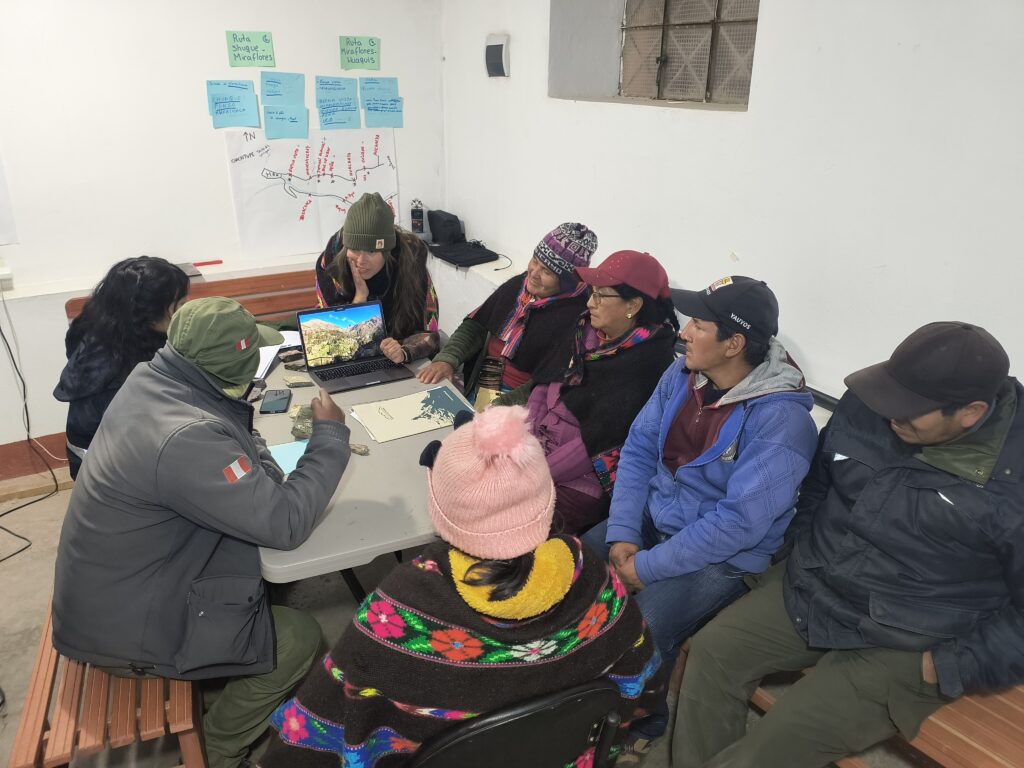
- In Peru, the community of Miraflores in Yauyos Province is creating the first geological trail within the Yanacancha-Huaquis Cultural Landscape. This initiative aims to strengthen resilience to climate change by promoting sustainable tourism and preserving cultural heritage.
- Across the United States, from California to Florida, 13 projects are engaging Spanish-speaking communities on issues ranging air quality to disaster preparedness.
In total, 23 Spanish-speaking projects have launched since 2024, showing how Thriving Earth Exchange has expanded its reach while embedding inclusion into the structure of global community science. By continuing to build existing partnerships, like EPIC-N, and focusing on communities along the US-Mexico border and tapping into existing relationships, we have significantly expanded the program’s reach.
Voices Driving Change
At the heart of Thriving Earth Exchange’s Spanish-speaking projects are the Community Leaders and the volunteer fellows and scientists who collaborate to bring science to life. They bridge worlds, connecting technical expertise with local knowledge, cultural context and lived experience. To ensure this collaboration is seamless, volunteer fellows are paired with Spanish-speaking communities only if they are bilingual.
After living in more than five different countries and furthering her academic research in evolutionary biology, Elvira Lafuente joined the September 2024 fellow cohort as a volunteer fellow on a project in Soacha, Colombia. She shared how this experience reconnected her with the tangible impact of her work:
“After years in research, I started feeling disconnected from the real-world impact of science. Community science offered a way to change that. It is incredibly rewarding to see people use science to tackle issues that matter to them, turning knowledge into action. For me, it is a way to re-engage with the world, make a tangible difference, and be part of something bigger.”
As a native-Spanish speaker from Spain, Elvira’s experience highlights how working in the community’s preferred language fosters trust and enables deeper participation.
This sentiment is echoed by community leaders like Ana Karen Novoa Rodríguez, from Coatepec, Mexico. Ana Karen joined the program hoping to find the tools and technical skills to advocate more effectively for conservation. She believes “a community organized with science can generate a historic impact.” Being able to engage in Spanish has been essential to empowering her community to contribute to conservation and climate resilience efforts.
Catalina Vigoya , a volunteer fellow on the Coatepec project, adds her perspective:
“Community science thrives when people can express themselves fully in their own language. That’s when real trust is built, and when innovative solutions emerge.”
Similarly, Almudena Sánchez de la Muela, a geophysicist and volunteer fellow on a project in Miraflores, Peru, notes how crucial it is to integrate local knowledge with scientific expertise.
“Thriving Earth Exchange’s program provides that means of communication and recognizes the need to bridge language barriers that are often present in community science projects.”
From the Gulf Coast of Texas to the mountains of Peru, language accessibility is crucial for inclusive community science. Thriving Earth Exchange supports this through bilingual materials, translation services, and careful attention to cultural context. By ensuring that knowledge, materials, strategies and processes are understandable and meaningful from the very start, we make science more accessible and equitable for everyone.
Our work over the past year is just the beginning. As we reflect on the importance of language inclusion during National Hispanic Heritage Month, we honor the invaluable contributions of Spanish-speaking communities, scientist and leaders who are driving change across the globe. Bridging language gaps has not only expanded our global reach but also enriched community science itself. We will continue to build on this momentum and are excited to continue this work and foster new partnerships, including at the Mexican Geophysical Union meeting in October, where project participants will be presenting on their work and sharing their stories.