A community science voice at Climate Week NYC
Shari Rose, Thriving Earth Exchange’s program manager for community leader engagement, brought an important community science perspective to Climate Week NYC, held September 20-27.
The nonprofit organization Climate Group organized the week, which featured events across New York City designed to bring together decision-makers and experts shaping capital, policy and markets across sectors and regions.
As a longtime Brooklyn resident, Rose has a personal connection to New York City that made participating in Climate Week especially meaningful.
“I care about what’s going on, and I love to hear what’s new when it comes to climate resilience and climate action,” she said. “For Thriving Earth Exchange, Climate Week gives us a chance to be at the frontier of innovation, see where major collaborations are developing, and think about how we can contribute or serve as a resource for the communities taking part in these events.”
Through several Climate Week NYC events, Rose had the chance to share Thriving Earth’s community science perspective while learning from the wide range of people and ideas shaping the climate conversation.
Making data useful
A key part of her week was serving as a panelist during the Activating Data Across Urban Environments session hosted by The New York Climate Exchange. During the panel discussion, which focused on deploying hyperlocal data, she emphasized that hyperlocal data isn’t just about gathering data on a smaller scale but also requires gathering data that is detailed enough to address problems at the scale communities experience them.
“Hyperlocal data is not only great for scientific inquiry and research, but it’s also for helping propel advocacy and policy changes,” she said. “This can sometimes be as small as a block or even an individual property.”
She pointed to some local Thriving Earth projects as examples, including one in Southeast Queens, where residents used an app to document flooding block by block and house by house, filling a gap in outdated city groundwater data and giving the community more specific evidence to bring to policymakers. Rose also highlighted a project in the Bronx that conducted a heat-vulnerability study that helped identify specific blocks that could benefit from tree plantings or cooling centers.
Keeping the community at the center
During the discussion, Rose also described the Thriving Earth approach in which the community defines its needs and questions first, before a scientist is ever brought in. She emphasized the importance of ensuring that communities have buy-in for data collection and said that it is critical to treat community-collected data as evidence, not an anecdote.
The need for funding to carry out plans for infrastructure development or policy decisions was another important point. “It’s key that scientists and experts work in tandem with the community-based organizations and individual community members to make sure that plans actually come to fruition and don’t just remain a vision,” she said.
Rose also participated in a break-out group discussion that focused on data sovereignty and accessibility, including efforts to preserve scientific datasets during crises or changes in government. The event concluded with a tour of the Governor’s Island Environmental Observatory, a NY Climate Exchange pilot project using solar power and a generator to collect and aggregate environmental data as part of the island’s broader development.
Connecting data and communities
Rose also attended a Climate Week NYC workshop focused on improving environmental data access for emergency preparedness in a changing climate. The workshop covered some new tools such as HIFLD Next, a free, interactive mapping tool that brings together more than 400 layers of infrastructure and other data that can be used online or downloaded for offline access. She said the mapping tool’s hyperlocal data could be particularly useful to communities working on issues such as critical infrastructure and wildfire preparedness.
Rose’s final event of the week was the BIPOC Climate Justice Summit at the American Museum of Natural History. Here, she connected with frontline communities, learned about their needs and gained insight into how Thriving Earth Exchange could continue to support them.
Rose said that one of her biggest takeaways at the end of the week was the continuing need for community input and accessible science communication, particularly around climate data. “We need to make sure that the funding and capacity is available to have better science communication for everyone at every level,” she said.
Through her participation in Climate Week NYC, Rose helped bring the voices and needs of communities into broader conversations about climate action and resilience. She also came away with new perspectives and tools she can use to help support communities as they use science to address climate challenges.
During the panel discussion, Rose noted that hyperlocal data isn’t just about gathering data on a smaller scale but also requires gathering data that is detailed enough to address problems at the scale communities experience them.
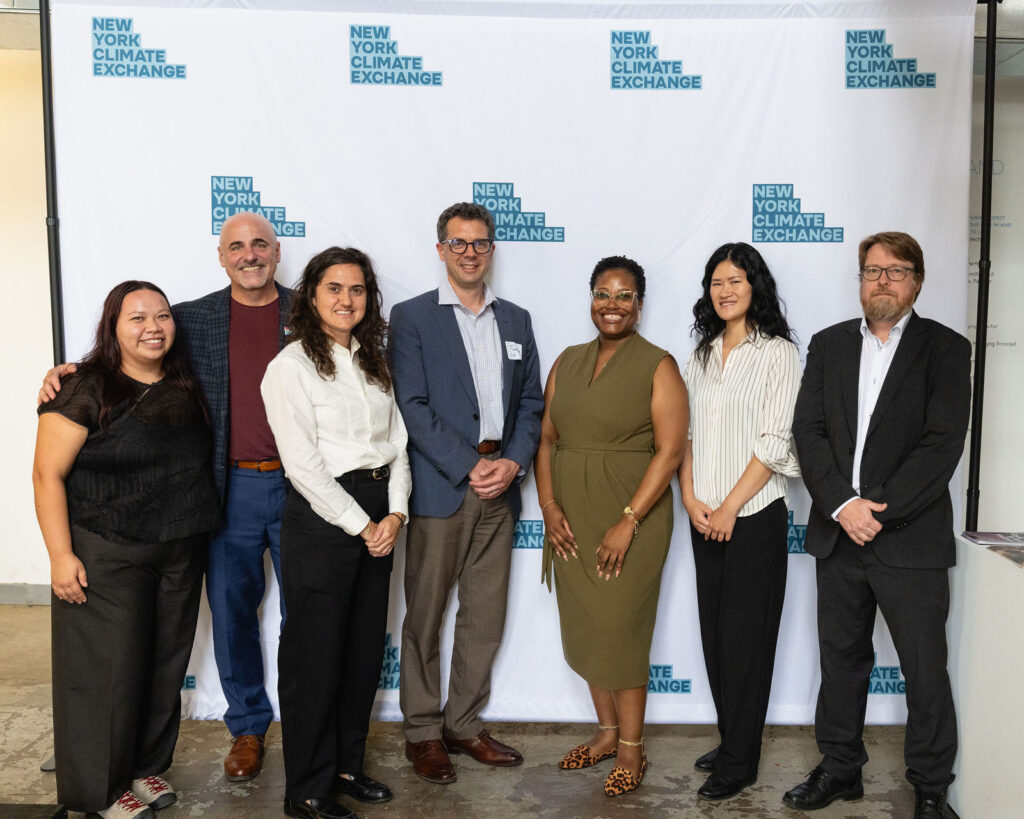
Shari Rose (third from right) with her fellow panelists at the New York Climate Exchange event. Courtesy of The New York Climate Exchange/photo by Ryan Kelly. 
Thriving Earth Exchange’s Shari Rose (third from left) served as a panelist during the Activating Data Across Urban Environments session hosted by The New York Climate Exchange. Courtesy of The New York Climate Exchange/photo by Ryan Kelly.
Courtesy of The New York Climate Exchange/photos by Ryan Kelly.