Community science helps schools cultivate food, culture and connection
Many families living in New Mexico’s Central Consolidated School District don’t have access to amenities like grocery stores, and some even lack basic infrastructure such as running water or electricity. The school district, based in Shiprock, New Mexico, encompasses nearly 3,000 square miles in the Four-Corners region and serves primarily indigenous communities both on and off the Navajo Nation reservation.
Community school coordinator Lisa Renner and the district’s school board have a vision of using schools to meet the community’s needs. “There may not be a grocery store, doctor’s office or even electricity or water at a lot of the houses, but schools have, or can provide, all of those things,” she said. “And because there are schools in each community, they bring a huge potential to serve the communities in many ways.”
One way this vision is taking shape is through food access and education. In partnership with the Thriving Earth Exchange’s Community Science Hub at the Center for Hazardous Substance Research at Kansas State University, and with support from the New Mexico Public Education Department, Renner has created programming that teaches students about traditional farming and food preparation practices via school-based gardens and local farmers who are Dine’ — the indigenous people of the Navajo Nation.
Learning through storytelling
As part of this program, students had the opportunity to visit a farm on the Navajo Nation reservation called Bidii Baby Foods, which grows heritage crops such as corn. During the field trip, the children experienced powerful storytelling and made important cultural connections. For example, Lyle Harvey told them about the cosmology of the people and how astronomy dictates the planting of crops.
“Field trips on the reservation are very infrequent, which made the experience even more meaningful,” said Renner. “The children saw themselves reflected in the farm’s owner Zach Ben, and his wife, Dr. Mary Ben, successful farmers and community members.”
Danielle Jim, who teaches at Mesa Elementary, said the field trip gave her students an important link to the farming traditions of Shiprock. “Many of our students come from the farming families of Shiprock and local areas,” she said. “So, this was an important field trip that provided many teachings about local farming and purposes through the Diné beliefs and cultural teachings.”
Creating school gardens
Renner and her partners are now creating school gardens that will be used for science lessons, health education and community-building efforts. “A garden offers so much—not only for children’s learning and their physical and mental well-being but also as a way to extend and deepen the curriculum while drawing on rich cultural traditions,” said Renner. “It also provides an important source of fresh vegetables for the community.”
Although many of the school garden plans are in their early stages, a middle school science teacher has already integrated gardening into her classes. Her students are growing traditional Navajo medicinal plants as well as cultural foods, such as baby bok choy, that are part of the teacher’s Filipino heritage.
In Shiprock, another school has purchased raised beds for gardening, and in Ojo Amarillo, a small orchard of 10 fruit trees was planted despite significant logistical challenges. “Progress is gradual, but meaningful, as the gardening and science initiatives continue to grow,” said Renner.
The high desert climate of this region brings significant challenges for gardening, with its lack of water, intense summer heat, strong winds, dust storms and cold winters. The large size of the district also makes it challenging for Renner to be on-site to help with logistics.
Community science coordinator Cam Chavez Reed, a doctoral student at the University of New Mexico, has been a valuable resource. “Cam has been very knowledgeable and supportive,” said Renner. “Having that sounding board while I’m trying to sort through all of these thoughts and applications and trials and tribulations has been really helpful.”
Growing through gardening
Reed also helped identify Cuauhtemoc Means Landeros as the community scientist for the project. Landeros is a tribal program manager with the Tribal Technical Assistance to Brownfields (Tribal TAB) program and will help deepen the scientific rigor for the project-based learning taking place at the schools.
“I’m not a gardener,” said Renner. “So, having a science partner to help with things like water usage and planting strategies will make our plans exponentially stronger.”
In addition to getting more teachers and schools involved in gardening, Renner is working to secure funding to bring in AmeriCorps volunteers through the Food Corps program, which would provide more “boots on the ground” support for the gardening and science activities. She also wants to scale the project to encompass additional grade levels and expand partnerships with more local farms.
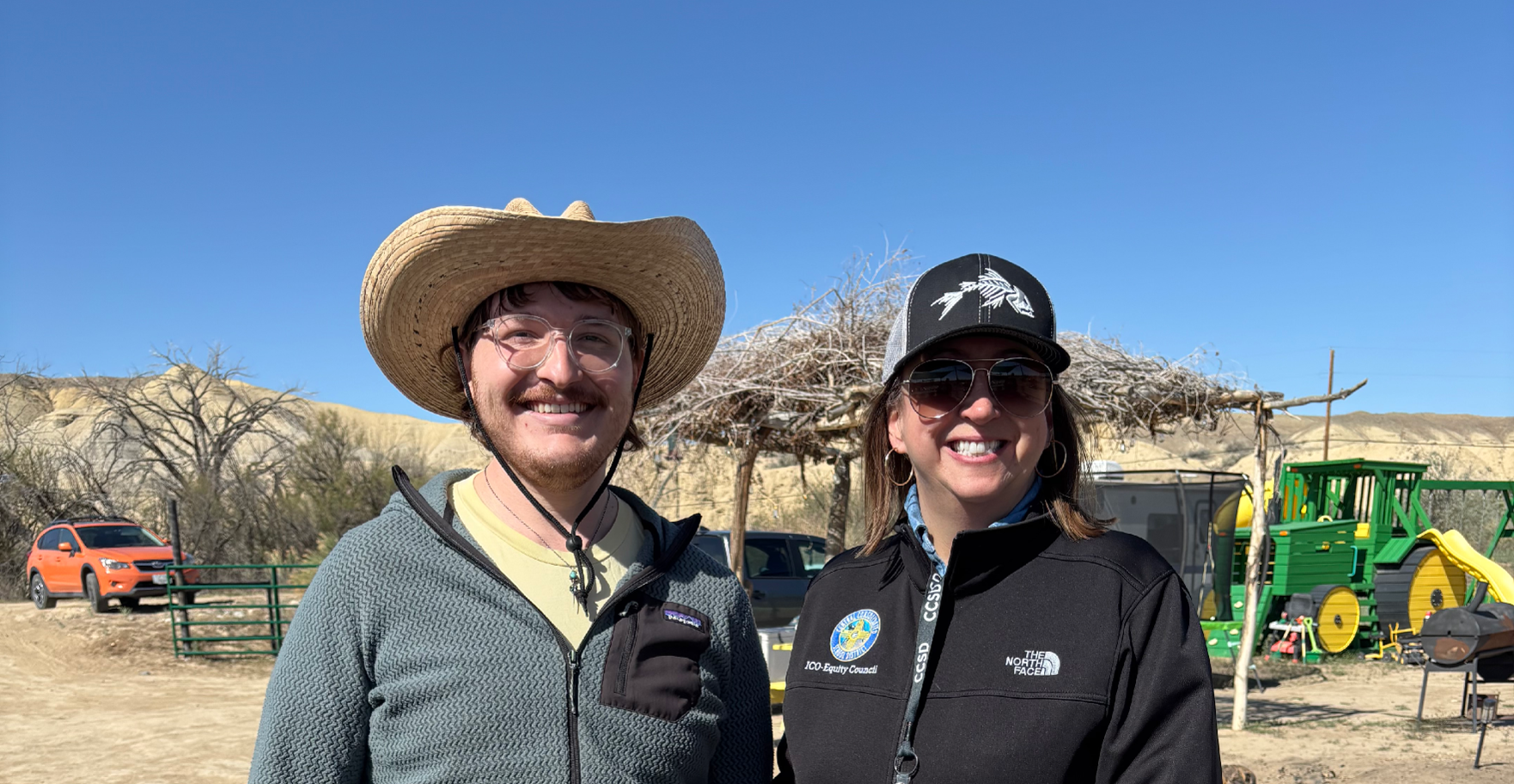
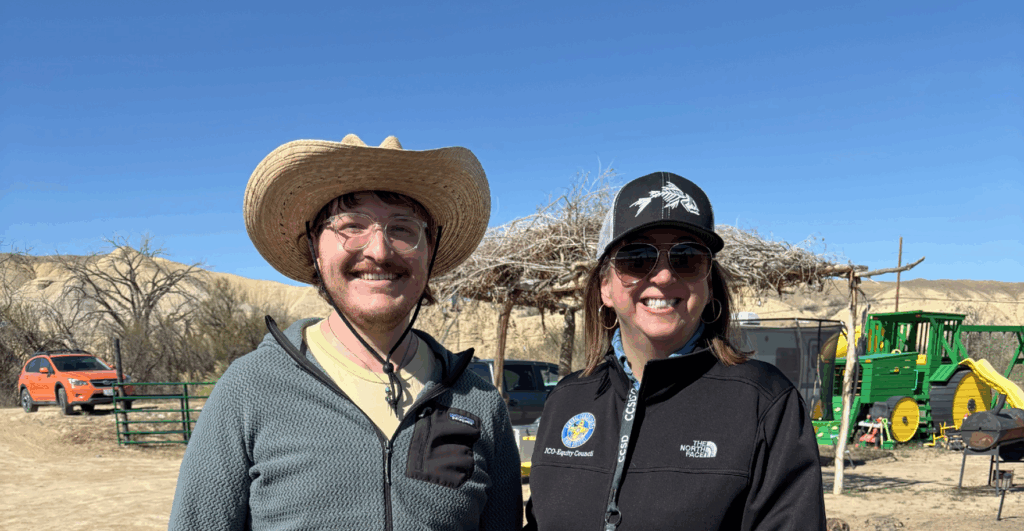 Community Science Fellow Cameron Chavez Reed and Community Leader Lisa Renner.
 Lyle Harvey demonstrates his clan’s planting stick during a field trip to a local farm.
 During the field trip, children planted traditional, heritage blue corn and were given some to take home.
 Children learn how to plant herbs in raised beds.


Community Science Hubs
This project is part of the Kansas State University Center for Hazardous Substance Research Community Science Hub and is supported in part through a generous grant from the Gordon and Betty Moore Foundation.