Community Science with Indigenous Communities
By Raj Pandya, TEX Director As much as anything, I hope that TEX can be a group of people learning and doing community science together. Learning together means sharing ideas, even ideas that aren’t…
In order to determine the environmental impact of their waste transfer station, the Evanston team plans to hold a public meeting describing the project strategy with city aldermen, scientists, and its environmental justice task force…
There’s data, data, everywhere—but does it apply to me? When it comes to climate, that’s the million-dollar question. While scientists deploy sophisticated on-the-ground sensors, satellites, crowdsourcing and big data tools to gain insights on climate…
Sometimes you want a custom-designed project just for you. Sometimes you want to learn from the experiences of others. At TEX, our peer-learning cohorts are designed to strike the right balance—and deliver results. The idea…
By Rebekah Lee, Boise State University This blog was originally posted on the AGU Blog, The Bridge: Connecting Science and Policy. Lee’s post is part of a series written by student bloggers from the AGU…
The model of fostering productive partnerships between scientists and people who aren’t professional scientists—what we call community science—continues to gain traction in ways big and small. Scientists across many disciplines are demonstrating a commitment to…
By Sarah Wilkins Attendees at Fall Meeting this year were greeted with the question: “What will you discover?” Between local field trips, AGU TV, e-lightning sessions and talks featuring cutting edge Earth and space science…
By Raj Pandya, Director, TEX In the early part of the 20th century, progress in New Orleans looked like transforming marshes into city blocks using engineered drainage. Neighborhoods that had been plagued by diseases associated…
Think of AGU’s Fall Meeting and the first impression that comes to mind is probably “huge.” Coming in at a close second is probably “science.” So why would community leaders from the far reaches of…
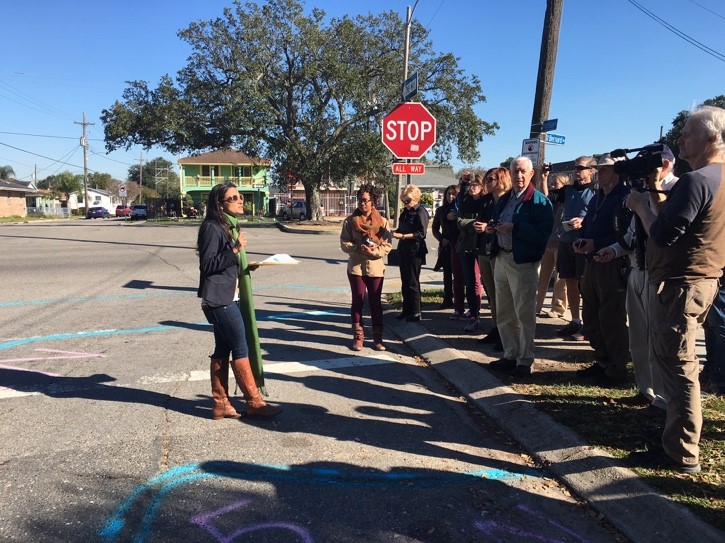
Water—and sometimes, flooding—is a fact of life for residents and planners in the city of New Orleans. Water has shaped the city’s infrastructure, history and culture for 300 years. In a four-hour field trip organized…
By Raj Pandya, TEX Director If you’ve read previous blogs, you know I’ve been thinking a lot about power, equity, and science. For me that means thinking about how being a scientist intersects with…
Two ongoing projects illustrate what can be accomplished when community advocates partner with TEX scientists to amplify their voice. In this two-part series, hear community leaders’ perspectives on the ins and outs of working with…
By Natasha Udu-gama Our recent Thriving Earth Exchange (TEX) project launch workshop opened on a lovely day in Pittsburgh on Friday, October 6th. The event followed AGU’s GeoPolicy Connect, a solutions-focused initiative designed to foster…
By Raj Pandya As you know, I’ve been thinking a lot about equity, power, and science. It isn’t a long walk from there to thinking about the appropriate role for a scientist in issues that…
Cities and towns are where the rubber hits the road when it comes to climate adaptation. It’s at the community level where key decisions are made about where to build, how to prepare for disaster…
By Raj Pandya, Director, Thriving Earth Exchange This blog was originally posted by Meeting of the Minds. It is a truth universally acknowledged, that a community in possession of a good population must be…
The recent devastation in Texas, Florida, South Asia and other areas has drawn a lot of attention to big questions about climate, development and the risk of future disasters. But if history is any guide,…
By Raj Pandya, TEX Director Science is entangled with issues of power, and community science – either explicitly or implicitly – is about exploring and challenging that entanglement. Grappling with these power dynamics can…
TEX works with communities to improve their resilience by leveraging Earth and space science to prepare for and mitigate the threats posed by destructive storms, flood and other hazards. Flood Forum USA supports grassroots flood groups…
In June, the team received feedback from an internal/external review (inclusive of local and technical scientific advisors) of the draft. Pending a few additional responses to comments and receipt of vulnerability maps from consultants, the…
Sometimes, a village isn’t enough. When grappling with complex problems like climate change or resilience, those who manage cities and counties often need to bring in expertise from beyond their local community and learn from…
By Anne Johnson The heat of the summer is not just a nuisance but a significant public health threat. In most years, extreme heat causes more deaths than any other type of weather-related disaster. The…
During the week of July 24, 2017, an impressive group of experts and practitioners from all over the world gathered in New York City to talk about urban resilience at the 100 Resilient Cities (100RC)…
By Raj Pandya In the last several months, I’ve had lots of prompts to think about how science fits into the wider world. It started with questions about a TEX project that seeks to use…
This article was initially posted in Eos on July 11, 2017. The Resilience Dialogues program provides resources and expertise to help communities build individualized plans for resilience in the face of climate change. By Nancy…
The 2016 Resilience Dialogues pilot supported five climate-savvy and well-resourced communities. We supported ten communities in our 2017 Beta, including several communities that have been historically underrepresented in climate adaptation efforts and several which were…
On 23 June 2017, the Evanston TEX team met with 3 Evanston aldermen, 3 community members and 5 Evanston city staff to discuss the budget for the proposed air quality monitoring work Gaj Sivandran intends…
TEX Director, Raj Pandya, participated in the first session of the University of Colorado Boulder Engaged Scientist Series. This program was designed to provide a source of knowledge and continued support for building relationships between…
After their introductory meeting in late March 2017, the Evanston TEX team has determined that its major deliverable will be to cost out what a monitoring plan would look like, inclusive of samples and instruments…
Subscribe to receive the latest new and opportunities from the Thriving Earth Exchange.